Why Is Original Research Becoming More Important for AI Search Visibility?
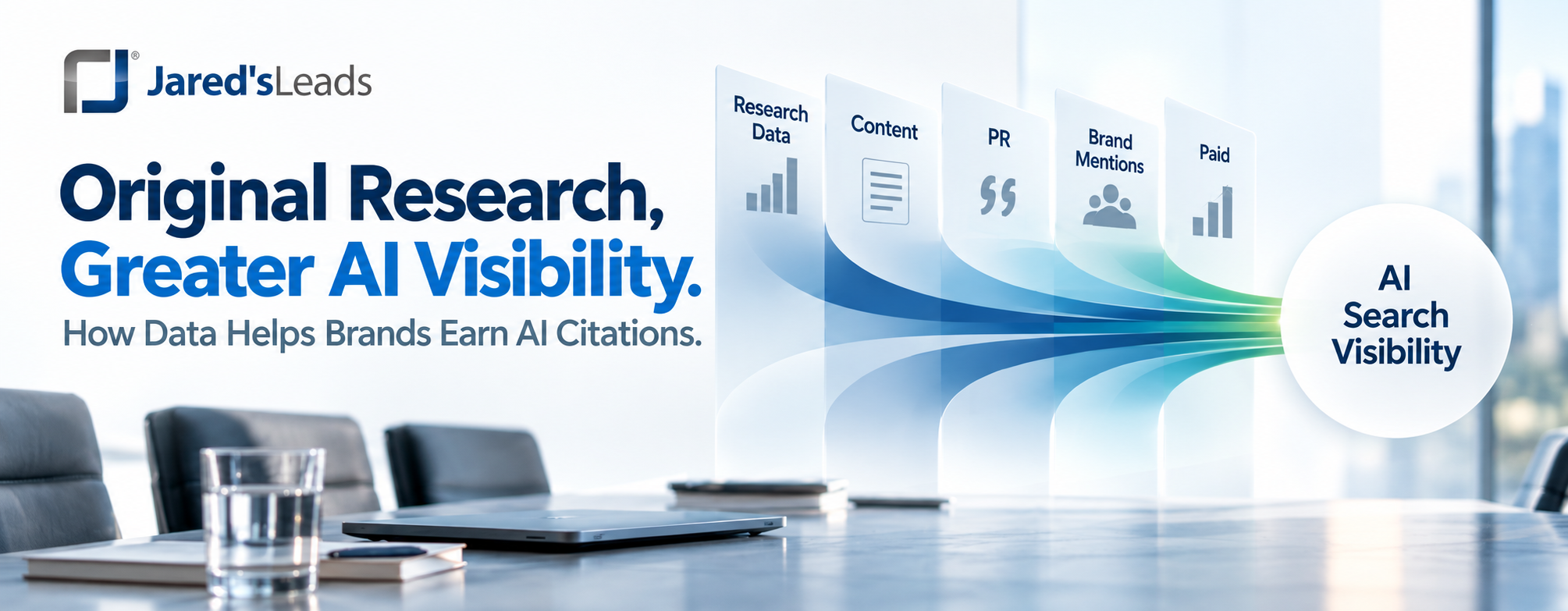
Original research is becoming an important consideration for businesses that want to appear in AI generated answers because it gives them an opportunity to contribute something beyond the information already repeated across competing websites.
Consider how many articles explain lead generation, customer acquisition, marketing automation, and search engine optimization. Most cover similar principles, repeat familiar advice, and reference statistics that have appeared in numerous other publications. When someone asks ChatGPT to explain lead generation, an AI system can produce a useful answer without necessarily citing a particular marketing company.
Now imagine a lead generation business publishes a carefully documented study examining how businesses evaluate lead quality, what influences purchasing decisions, or which challenges sales teams encounter when working with different lead sources. If the findings are credible and relevant to a question being asked, that research provides information that may be useful to other businesses, industry publications, and AI powered search platforms.
This is the distinction companies need to understand. Generic content primarily explains existing information, whereas original research contributes new evidence, observations, or analysis. For companies investing in LLM SEO and AI visibility, developing that contribution can be an opportunity to establish a more distinctive position within their industry.
Original research does not guarantee that ChatGPT, Gemini, or Perplexity will cite a particular website. AI platforms use different retrieval and response generation methods, and their citations can vary considerably. However, publishing useful evidence gives a business a stronger informational contribution than simply rewriting what competitors have already published.
What Counts as Original Data for SEO and AI Search?
Original data is information that an organization collects, generates, or analyzes directly, while proprietary research generally refers to work based on information the organization owns or has legitimate rights to use. This does not necessarily mean conducting a large academic study. Many businesses already possess useful information within their sales, marketing, customer service, and operational systems.

A lead generation company, for example, might examine customer preferences, recurring questions from buyers, campaign engagement, or the factors businesses consider when evaluating data providers. An eCommerce company might analyze customer satisfaction, purchasing behavior, product returns, or questions that repeatedly arise before a purchase. These observations can become valuable research assets when the information is collected responsibly and interpreted accurately.
Customer surveys, documented experiments, internal data analysis, and case studies are all possible starting points. A survey can reveal what buyers prioritize when selecting a provider, while a case study can explain how a business addressed a specific challenge and what happened afterward. Internal data can also reveal patterns that help answer practical questions, provided the analysis is appropriate and the findings can be shared without exposing confidential information.
The important distinction is between having information and producing a defensible finding from it. A company should not present an existing industry statistic as its own discovery or describe a hypothetical example as actual customer research. The strongest research explains where the information came from, what was measured, and what conclusions the evidence can reasonably support.
How Do ChatGPT, Gemini, and Perplexity Decide Which Sources to Cite?
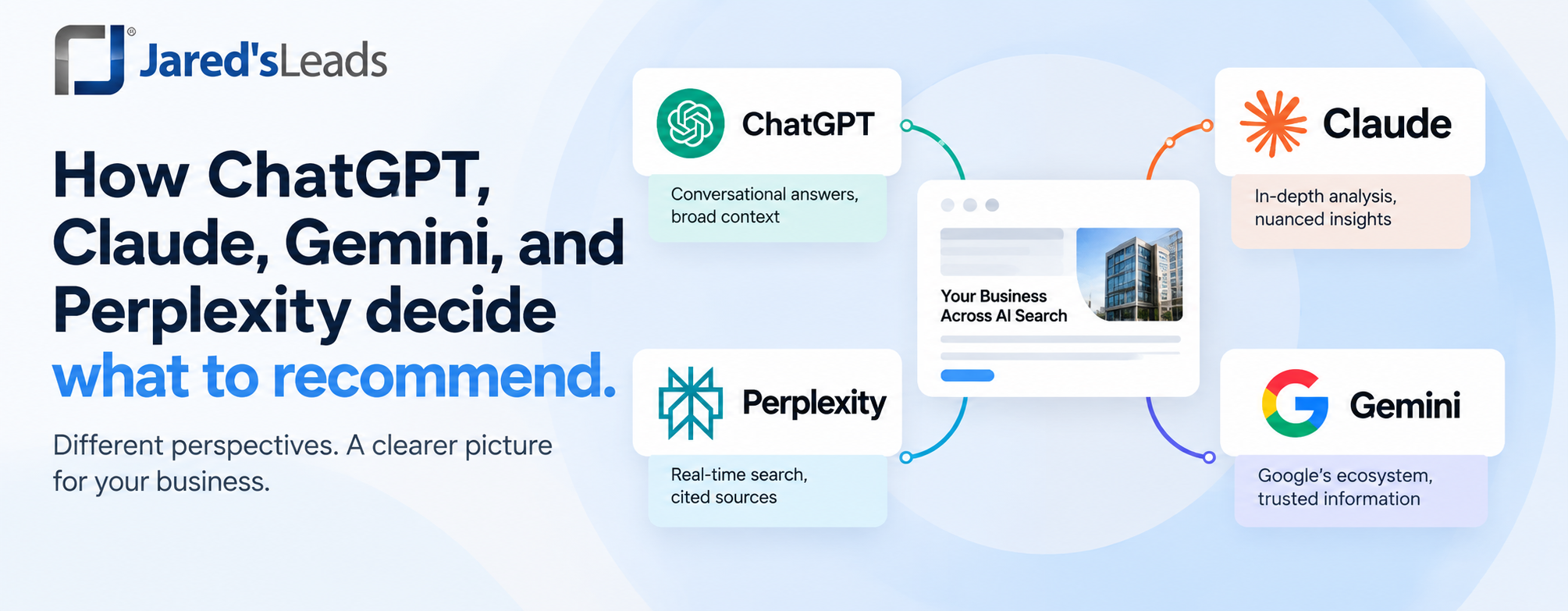
There is no single universal formula for earning citations across AI search platforms. Depending on the product and the question, an AI system may use its existing model knowledge, retrieve current web information, examine relevant pages, or combine information from multiple sources before generating an answer.

Suppose a business owner asks which factors matter when selecting a lead generation provider. An AI system may need information about targeting, data accuracy, lead quality, compliance, pricing, and service capabilities. A page that explains these subjects clearly and supports its claims with relevant evidence may be useful to the response. A page that simply repeats broad marketing promises may contribute less.
Original research can provide a distinctive source of evidence, but its usefulness depends on more than originality. The page must be accessible to the relevant retrieval system, the findings must address the question, and the information must be understandable within its context. External references, independent coverage, and the broader quality of a company’s online presence can also contribute to how its expertise is discovered and evaluated.
Businesses should therefore monitor actual AI visibility rather than assuming that publishing a well written article will automatically produce citations. Jared’s Leads explains this process in its guide to AI citation audits, which examines the sources appearing in AI generated answers and identifies opportunities to improve a brand’s visibility.
Why Does Content Structure Matter When Publishing Original Research?
Even valuable research can be difficult to use when its most important findings are buried in lengthy introductions or surrounded by unclear explanations. Readers need to understand what the research discovered, how the information was obtained, and why the findings matter. Clear structure helps make that possible while also making the content easier for search and retrieval systems to interpret.

A research article should introduce its central question, present its main findings, explain the methodology, and discuss the implications. If a survey included 120 participants, for example, the article should disclose that sample size and explain how participants were selected. If the respondents came from one particular industry, the findings should not automatically be presented as representative of the entire business population.
Question based headings can make individual sections easier to navigate, particularly when the heading reflects a question customers genuinely ask. Tables and charts can help readers compare findings, while descriptive captions and supporting paragraphs explain what the numbers represent. Internal links can connect the research to relevant service pages and supporting articles, allowing readers to explore the subject in greater depth.
Important findings should appear where readers can find them naturally, rather than being hidden near the end of a page. However, content should not be forced into a rigid format merely to satisfy assumptions about AI algorithms. The objective is to communicate evidence clearly, provide sufficient context, and make the page useful to its intended audience. Structured data can support accurate interpretation by compatible systems, but it cannot compensate for weak research or guarantee citations.
How Can Small Businesses Create Original Research Without a Large Budget?
Small businesses can begin producing original research without hiring a dedicated research team or commissioning an expensive industry report. The most practical starting point is often an important customer question that the company can investigate using information it already has or can reasonably collect.

A lead generation company might survey business owners about the factors they consider when choosing a provider. A marketing agency could document a genuine campaign experiment, explaining the changes made and the results observed. A software company might analyze recurring customer questions to identify the operational challenges that deserve more attention.
The process should begin with a focused question, followed by the selection of a suitable data source and a clearly defined methodology. Once the information has been collected, the company should check its calculations, examine possible limitations, and obtain appropriate review before publishing the findings. The final article should explain what was learned and how the information might help readers make better decisions.
Small sample sizes are not automatically a problem, but they need to be interpreted honestly. A survey of 50 businesses may provide useful insight into those participants without representing an entire industry. Similarly, an observed improvement in one campaign does not prove that every business using the same approach will achieve identical results. Transparent reporting is more valuable in the long term than making an impressive claim that the evidence cannot support.
How Can AI Automation Help Businesses Produce Better Research Content?

AI automation can make research workflows more efficient by helping teams organize survey responses, categorize customer questions, summarize information, and prepare preliminary content from verified findings. Instead of manually reviewing every response or repeatedly creating different versions of a report, businesses can use automation to handle suitable repetitive tasks while people focus on interpretation and accuracy.
For example, a company could use an approved workflow to categorize customer inquiries, identify recurring themes, and prepare an aggregated summary for review. A responsible reviewer would then examine the classifications, confirm that the findings are supported by the data, and decide which observations are suitable for publication. Once approved, the findings could be adapted into a research article, an executive summary, or supporting educational content.
This approach can connect research with a wider marketing process, but the underlying evidence must remain reliable. AI systems can misclassify responses, produce inaccurate summaries, or suggest relationships that the data does not support. Businesses must also protect personal information, respect contractual obligations, and apply appropriate privacy controls before using customer records.
Automation is most useful when it makes a reliable process faster and more consistent without removing the checks that make the research trustworthy. For businesses exploring AI driven marketing, this means combining efficient workflows with human judgment rather than allowing automated systems to publish unverified conclusions.
How Does E-E-A-T Help Build Credibility for Original Research?
E-E-A-T stands for Experience, Expertise, Authoritativeness, and Trustworthiness. Google’s guidance uses these concepts to describe qualities associated with helpful and reliable content. E-E-A-T is not a single score that guarantees search rankings or AI citations, but its principles provide a useful framework for producing credible research and educational articles.

Experience involves demonstrating genuine involvement with the subject, while expertise means showing an appropriate understanding of the topic. Authoritativeness develops when a business becomes recognized as a reliable contributor within its field, and trustworthiness requires accurate information, transparent methods, proper attribution, and honest reporting. These qualities should be reflected in the content itself rather than asserted through unsupported credentials.
For Jared’s Leads, that means identifying the author, linking to credible external sources where appropriate, explaining the limitations of research, and distinguishing established findings from general recommendations. Jared Knapp is the founder of Jared’s Leads, and his professional focus includes lead generation and customer acquisition. His work on AI visibility and AI related marketing provides a relevant perspective for discussing how businesses can approach these emerging areas.
That author positioning should not imply that Jared personally conducted a research study when no such study exists. Technical claims should be supported by credible references, and the author biography should accurately represent his experience. Readers are more likely to trust content when its authorship and evidence are presented transparently.
How Should Businesses Measure the Impact of Original Research on AI Visibility?
Businesses should evaluate whether original research is improving their visibility for relevant questions, rather than relying only on article traffic or the number of times their brand appears in AI generated answers. A mention for a broad educational question may have little commercial value if the audience is unrelated to the company’s services, while visibility for a specific buyer question may be more meaningful.

The first step is to identify the questions customers ask when researching problems, comparing providers, and deciding what to purchase. These questions can then be tested across relevant AI platforms over time. Businesses can monitor brand mentions, direct citations, the quality of cited sources, competitor visibility, the accuracy of brand descriptions, and referral traffic where measurable.
These metrics should be interpreted together. AI responses can change across platforms, queries, and individual sessions, so a single test should not be treated as a definitive measure of visibility. Tracking should also distinguish broad informational questions from high intent questions that reflect an actual purchasing decision.
Jared’s Leads explores this issue in its article on AI search visibility tracking, which discusses the importance of measuring prompts that reflect real buyer behavior. The broader objective is to understand whether a business is becoming easier to discover when potential customers are researching the products or services it provides.
How Can Jared’s Leads Help Businesses Improve AI Visibility?
Businesses often need more than another content calendar. They need to understand how their company appears across AI search platforms, which sources influence those answers, and which improvements could help them become more discoverable. Jared’s Leads provides LLM SEO and AI visibility services designed to help businesses examine these questions and develop a practical improvement strategy.

The process begins by understanding the business, its target audience, its services, and the questions potential customers ask. An AI visibility assessment can help identify relevant prompts, competing brands, citation sources, and possible gaps in the company’s online presence. Those findings can inform decisions about content development, technical optimization, entity building, third party references, and ongoing measurement.
Original research can support that strategy when the business has useful data or a worthwhile question to investigate. One company may have customer insights that have never been organized into a public resource, while another may have documented case studies that need clearer explanations and stronger supporting context. AI automation can streamline preparing and distributing approved content, while human review protects accuracy.
The goal is not to promise a specific number of AI citations. It is to help businesses build a more credible and useful online presence that reflects their actual expertise and meets customer needs. Companies can explore Jared’s Leads to learn more about its approach to LLM SEO and AI visibility, or visit the Contact Us page to discuss their requirements.
Frequently Asked Questions About Original Research and AI Citations
Q.1. Does original research guarantee citations from ChatGPT?
No. Original research can provide useful evidence that AI systems may reference, but citations depend on relevance, accessibility, retrieval, and other platform-specific factors. No publishing technique can guarantee that a particular page will appear in an AI generated answer.
Q.2. What is the difference between original research and regular SEO content?
Regular SEO content often explains information that is already available elsewhere, while original research contributes new data, documented observations, or analysis. Both can support a content strategy, but original research may provide a more distinctive informational contribution when it addresses a meaningful question.
Q.3. Can small businesses publish original research?
Yes. Small businesses can conduct customer surveys, analyse authorised business data, document experiments, and publish case studies. The research should explain how the information was collected and disclose important limitations so readers can interpret the findings appropriately.
Q.4. Can AI automation help produce original research?
AI automation can assist with organizing information, categorizing responses, preparing summaries, and adapting verified findings into different formats. The data must be genuine, and the conclusions should be reviewed before publication because automated systems can make mistakes.
Q.5. How does E-E-A-T relate to AI visibility?
E-E-A-T describes Experience, Expertise, Authoritativeness, and Trustworthiness. These principles encourage accurate, useful, and credible content, although they are not a direct formula for earning AI citations.
Q.6. How can Jared’s Leads help improve AI visibility?
Jared’s Leads offers AI visibility and LLM SEO services that can help businesses examine their presence across AI search platforms, identify content and citation gaps, and develop a strategy for improving discoverability. The appropriate approach depends on the business, its existing content, and its target customers.
Conclusion: Why Should Businesses Invest in Original Research for AI Search?
AI search is changing how customers discover and evaluate businesses, but the underlying value of credible information remains important. Companies that contribute useful evidence can offer more than another explanation of familiar concepts. Their research can answer customer questions, demonstrate practical expertise, and create resources that other websites and AI powered search systems may find useful.

The opportunity does not require every company to commission an expensive study. It begins with understanding what the business knows, which questions its customers need answered, and whether reliable information can help answer those questions. Publishing the findings responsibly, explaining their limitations, and connecting them to relevant resources can turn that knowledge into a lasting content asset.
AI automation can make the process more efficient, while human expertise and transparent methodology protect its credibility. For businesses seeking stronger visibility across ChatGPT, Gemini, Perplexity, and other AI search experiences, original research can become one part of a broader strategy involving useful content, technical accessibility, legitimate authority, and meaningful measurement.
The goal is not simply to publish more articles. It is to contribute information that people can trust, other sources can reference, and AI systems may find useful when answering relevant questions. Businesses that begin with genuine customer needs and credible evidence will be better positioned to adapt as AI powered discovery continues to evolve.
To discuss how this approach could support your business, visit Jared’s Leads or contact the team to explore your AI visibility goals.