Introduction: AI Needs to Understand More Than Your Keywords
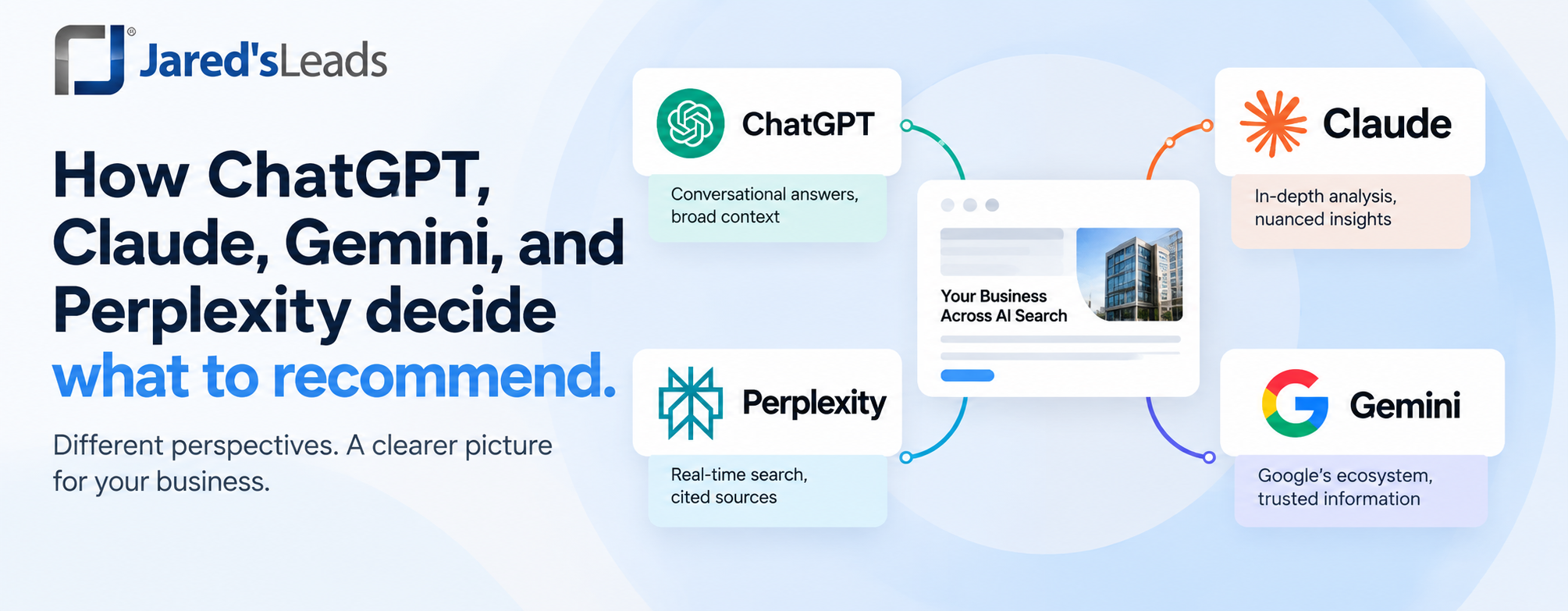
For years, SEO has largely revolved around keywords. Businesses identified the phrases their customers were searching for, created content around those terms, optimised their websites, built links, and worked to improve their rankings in traditional search results. That approach is still important, but the way people discover businesses is changing. Today, a potential customer can ask ChatGPT, Gemini, Perplexity, or another AI-powered search platform a detailed question and receive an answer that brings several companies, products, services, and sources into the conversation without requiring the user to work through a traditional search results page.
That creates a different challenge for businesses. It is no longer enough for an AI system to find the words associated with your company. It needs to understand what your company actually is, what you offer, who you serve, where you operate, what subjects you have expertise in, and how all of those pieces relate to one another. This is where entity SEO becomes increasingly important. Jared’s Leads describes its LLM SEO services around making businesses easier for AI systems to understand, trust, and recommend, using a combination of entities, structured content, authority signals, citations, and ongoing AI visibility measurement.
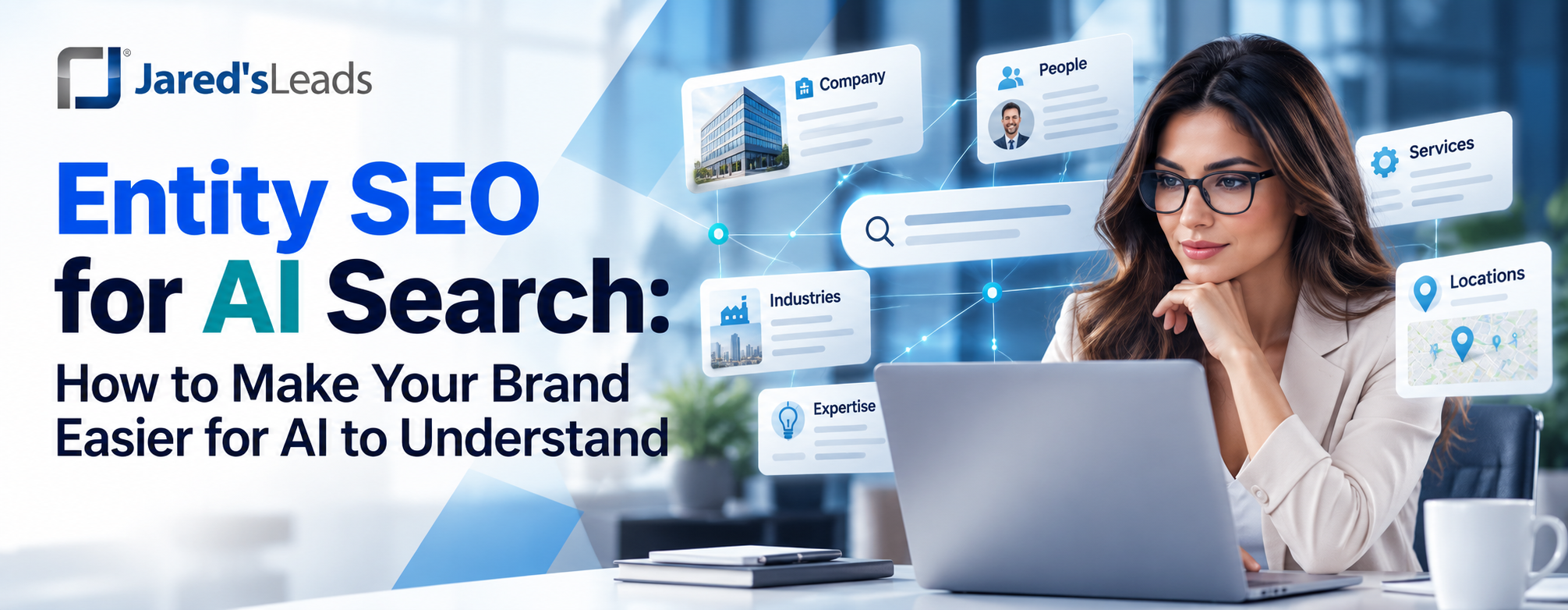
The idea behind entity SEO is relatively simple, even though implementing it properly can become quite sophisticated. Instead of treating a business as a collection of keywords and individual webpages, entity SEO looks at the business as a connected subject. The company itself is an entity. Its founder is an entity. Its products and services are entities. The industries it serves, locations it operates in, technologies it uses, and subjects it is known for can all become part of that broader information network. The stronger and more consistent those relationships are, the easier it becomes for search engines and AI systems to build an accurate understanding of the business.
What Is Entity SEO?

Entity SEO is the process of helping search engines and AI systems understand the important entities associated with a business and the relationships between those entities. An entity can be a company, person, product, service, location, organisation, brand, topic, or another clearly identifiable subject. In practical terms, entity SEO moves the conversation beyond the question of which keyword appears on a webpage and toward a much broader question:
What does this business represent?
Consider a company that provides lead generation services. A traditional SEO strategy might focus on phrases such as “lead generation company,” “B2B leads,” “business mailing lists,” or “sales leads.” Those keywords are useful, but they do not tell the complete story. An AI system may also need to understand that the company provides B2B data, works with particular industries, offers consumer lists, provides real-time leads, has a specific founder, operates in particular markets, and has expertise in certain types of customer acquisition.
That additional context matters because modern AI search often involves much more than matching a phrase. A customer might ask, “Which companies provide reliable B2B lead data for healthcare businesses?” The system has to understand the concepts behind the question, identify businesses associated with those concepts, and determine which companies appear relevant enough to include in its answer.
This is why a business’s entity footprint can become important. The goal is not to repeat the same company name across the internet or insert a keyword into every paragraph. The goal is to create a clear, accurate, and consistent understanding of the business and the subjects connected to it.
Why Entity SEO Matters More in AI Search

AI search has changed the way a user can approach discovery. Instead of beginning with a short keyword such as “B2B lead generation,” a buyer can describe a problem in much greater detail. They can mention their industry, company size, location, budget, customer type, goals, and specific requirements in one question. An AI system can then interpret that context and produce a response based on what it determines to be relevant.
That means businesses need to be understood within context, not simply associated with isolated keywords. Jared’s Leads’ current AI visibility framework makes a similar distinction in its approach to measuring AI search. Rather than relying entirely on broad generic prompts, its methodology focuses on buyer context, intent, and the specific situations in which potential customers are actually evaluating providers.
Imagine that an AI system receives the question, “What are some companies that provide targeted marketing data for mortgage businesses?” To answer that properly, the system needs to connect several ideas. It needs to understand marketing data, mortgage businesses, lead generation, targeting, and the companies that operate within that space. It may also need information about the providers’ services, industry experience, reputation, and other sources that support those associations.
This is fundamentally different from simply asking whether the phrase “mortgage marketing data” appears on a webpage.
That is where entity SEO becomes useful. By clearly establishing the relationships between your company, its services, its expertise, its audience, and the subjects it covers, you give search engines and AI systems more context with which to interpret your business. This does not guarantee that an AI platform will mention or recommend the company, because AI visibility depends on many factors, but it can create a much stronger foundation for being understood correctly.
Businesses that want to explore this broader approach can also review the Jared’s Leads LLM SEO packages, which are designed around areas such as AI visibility, entity building, content optimization, authority development, and ongoing visibility improvement.
What Information Makes Up a Business Entity?

A business entity is made up of considerably more information than its company name and homepage. When a customer tries to understand a company, they want to know what it does, what it sells, who it serves, where it operates, who is behind it, and why they should consider it. AI systems have many of the same information needs when they attempt to generate a useful answer.
The first layer is the company’s core identity. This includes the official business name, website, organisation information, location, leadership, and other identifying details. The next layer consists of products and services. Each important service should be clearly explained so that there is little ambiguity about what the company actually provides. If a business offers LLM SEO, AI visibility audits, entity development, content optimisation, and citation work, those relationships should be clear rather than scattered randomly across unrelated pages.
The next layer involves audiences and industries. A company may work with healthcare organisations, law firms, SaaS companies, e-commerce brands, financial services companies, or local businesses. Those relationships become part of the broader picture of the business. If the company consistently demonstrates expertise in those industries through its website, content, profiles, and relevant external references, the association becomes much clearer.
Then there are people and relationships. A founder or subject matter expert can be an important part of the business’s broader entity footprint. The relationship between a founder and a company, between a company and a service, and between a service and an industry can all contribute to how the organisation is understood.
The important point is that these relationships should reflect reality. Entity SEO is not about manufacturing associations simply because a business wants to appear for a particular query. The information needs to be accurate, useful, and supported by the company’s actual activities.
Entity Relationships Are More Important Than Isolated Keywords

One of the easiest mistakes to make with AI search is to continue thinking about SEO entirely in terms of individual keywords. A business might identify a hundred phrases related to its services, create pages around those phrases, and assume that more keyword coverage will automatically result in stronger AI visibility. The problem is that AI systems are capable of interpreting relationships between subjects, which means a collection of disconnected keyword pages may not create the same level of understanding as a well-connected topical ecosystem.
Think about a company that provides LLM SEO. Its website might contain a page about AI visibility, another page about entity SEO, another about AEO, another about citations, and another about traditional SEO. If those pages are treated as completely separate subjects, the website misses an opportunity to demonstrate how the concepts relate to one another.
A stronger structure explains those relationships naturally. LLM SEO can be presented as the broader service. Entity SEO can be explained as one component of helping AI understand a business. AEO can be connected to optimizing information so AI systems can interpret and use it. Citation building can be connected to external authority and brand references. Traditional SEO can be explained as an important foundation that works alongside these newer AI-focused activities.
Jared’s Leads takes a similar connected approach across its published resources. Its AEO guide discusses clear content, structured information, authority, consistent business information, and citations as connected elements of AI visibility rather than isolated tactics.
This is also why internal linking matters. When a page about entity SEO naturally links to a page about LLM SEO, and that page connects to AI visibility, AEO, or a relevant package, the website creates a clearer information path for both users and search engines. Internal links should not be added simply to increase the number of links on a page. They should help explain how related subjects fit together.
The Role of Structured Data and Schema
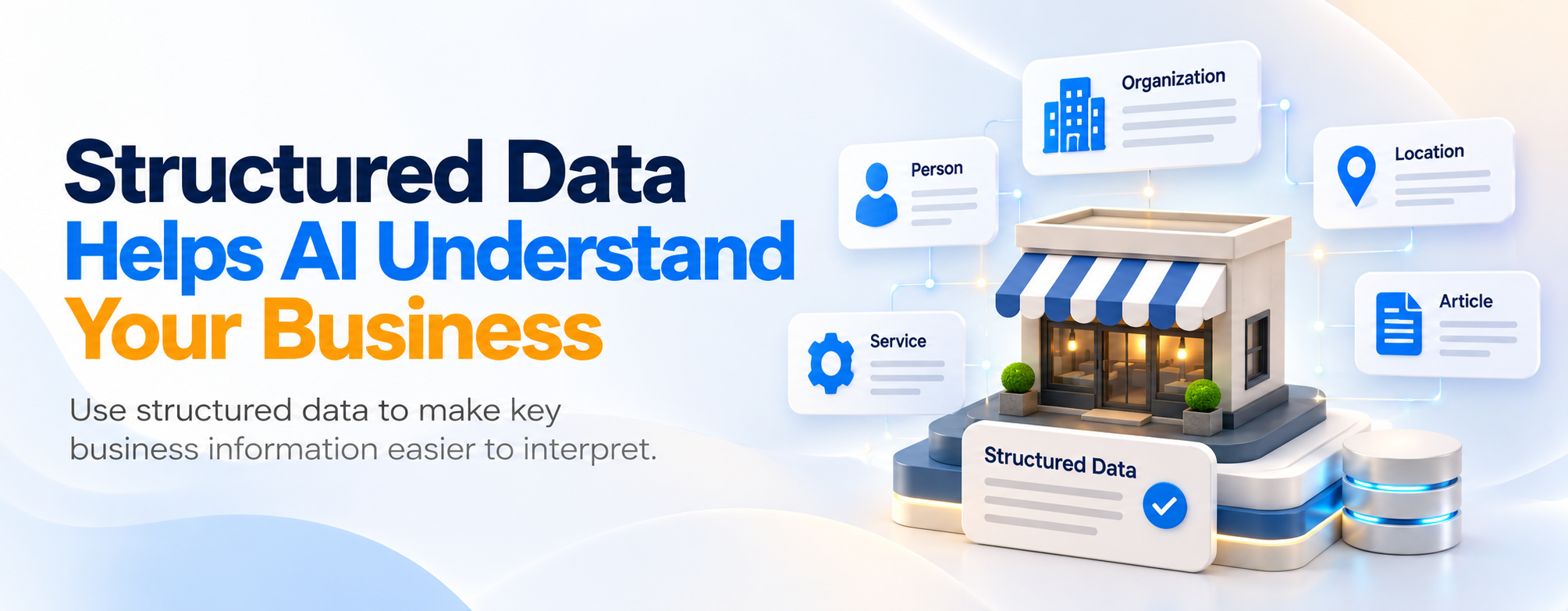
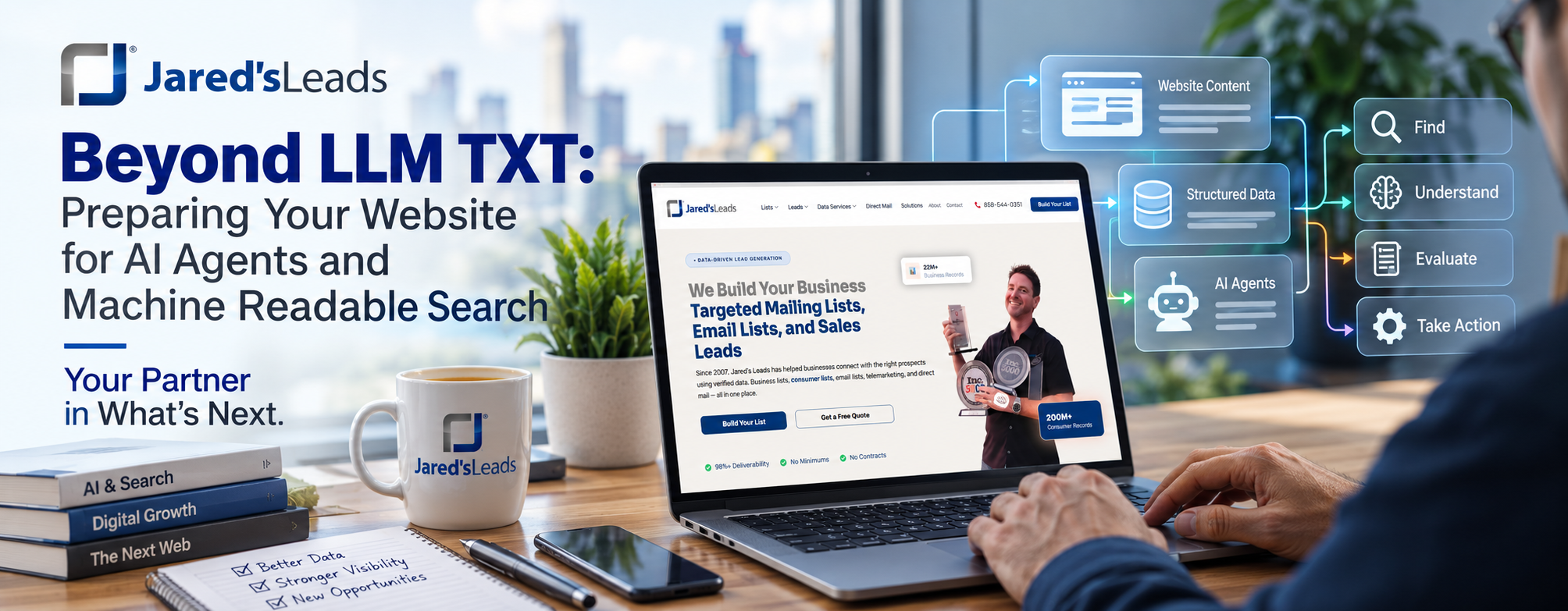
Structured data is another important part of entity SEO because it gives search engines additional machine-readable information about the subjects described on a webpage. Depending on the situation, structured data can help communicate information about organizations, people, services, products, articles, locations, and other entities.
However, it is important not to treat schema as a magic solution.
Adding Organisation schema to a website does not automatically make a company authoritative in AI search. Structured data is most useful when it supports information that is already clear and consistent across the website and broader digital presence. If the website says one thing about the company while important external profiles say something completely different, adding schema does not resolve the underlying inconsistency.
For example, suppose a company describes itself as an LLM SEO agency on its website but several major business profiles describe it primarily as a general web design company. That difference may create ambiguity about what the company actually specializes in. A stronger entity strategy would first address the accuracy and consistency of the information before relying on structured data to reinforce it.
Jared’s Leads’ published AEO guidance similarly places schema alongside other elements such as clear content, topical authority, consistent business information, and credible citations. This is the right way to think about structured data. It is one layer within a much larger information system, not a substitute for building a credible digital presence.
For businesses working on AI visibility, the practical objective should be to make important information clear to both humans and machines. Your company name, services, leadership, industries, locations, expertise, and other important information should be accurate, understandable, and consistent wherever those facts legitimately appear.
How to Build a Strong Entity SEO Strategy

Building a strong entity SEO strategy starts with defining the business clearly. Before creating new content or building external profiles, a company should be able to explain its core identity, services, target customers, industries, expertise, locations, leadership, and important products without confusion. This sounds straightforward, but many businesses discover that their own website contains several different descriptions of what they do.
Once the core identity is clear, the next step is to map the important entities connected to the company. This can include founders, executives, products, services, industries, technologies, locations, associations, publications, and other subjects that are genuinely relevant to the business. The goal is to understand not only which entities exist, but how they relate to one another.
The next stage is creating useful content around those relationships. If a company wants to establish expertise in AI search, it should not publish dozens of unrelated articles about AI simply because those topics have search volume. The content should reinforce the company’s actual expertise and answer the questions potential customers are asking. A strong content ecosystem can include educational guides, comparisons, research, case studies, service explanations, FAQs, and deeper resources that collectively demonstrate knowledge of the subject.
External authority is another important part of the process. AI systems do not rely exclusively on a company’s own website. Business directories, industry publications, professional profiles, reviews, interviews, articles, and other relevant sources can all contribute information about a company. Jared’s Leads’ own LLM SEO framework includes promotion through mentions, citations, and quality backlinks as part of strengthening trust across the wider web.
Finally, the strategy needs to be measured. A company should regularly test realistic questions across relevant AI platforms and look at whether it appears, how it is described, which competitors appear instead, and which sources are being referenced. Jared’s Leads’ recent work on AI visibility tracking emphasizes using buyer-focused prompts and looking beyond a single visibility percentage to understand gaps across buyer intent, platforms, and competitors.
Common Entity SEO Mistakes Businesses Should Avoid

One of the most common mistakes is treating entity SEO as a keyword stuffing exercise. Repeating the company name, service name, and industry terminology throughout a website does not automatically create a stronger entity. In fact, excessive repetition can make the content less useful to the people reading it. The better approach is to explain the business naturally and provide enough context for the relationships to become clear.
Another problem is inconsistent information. If a company has different descriptions, service offerings, locations, or leadership information across important online profiles, it becomes harder to establish a consistent digital identity. Businesses should periodically review their most important profiles and make sure the information is accurate and current.
Creating too many low-quality profiles is another common mistake. Entity SEO is not a numbers game where having 500 profiles is automatically better than having 20. A smaller number of accurate, relevant, authoritative profiles can be considerably more useful than a large collection of poorly maintained listings.
Businesses should also be careful about confusing mentions with authority. A company being mentioned somewhere on the internet does not automatically make that source valuable. Context, relevance, credibility, and the quality of the publication or platform matter. The objective should be to earn legitimate recognition in places that are relevant to the business rather than simply collecting mentions.
Finally, businesses should avoid treating entity SEO as a one-time project. AI search continues to change, competitors publish new content, third-party sources change, and the questions buyers ask evolve. Jared’s Leads’ own AI visibility work emphasizes ongoing measurement because visibility can differ between platforms and between broad informational queries and decision-stage searches.
How Jared’s Leads Can Help With Entity SEO

Entity SEO becomes considerably more valuable when it is connected to a broader AI visibility strategy. Instead of simply optimizing a company’s homepage or adding schema to a few pages, the process can look at how the business is represented across its website, content, profiles, citations, external sources, and AI-generated answers.
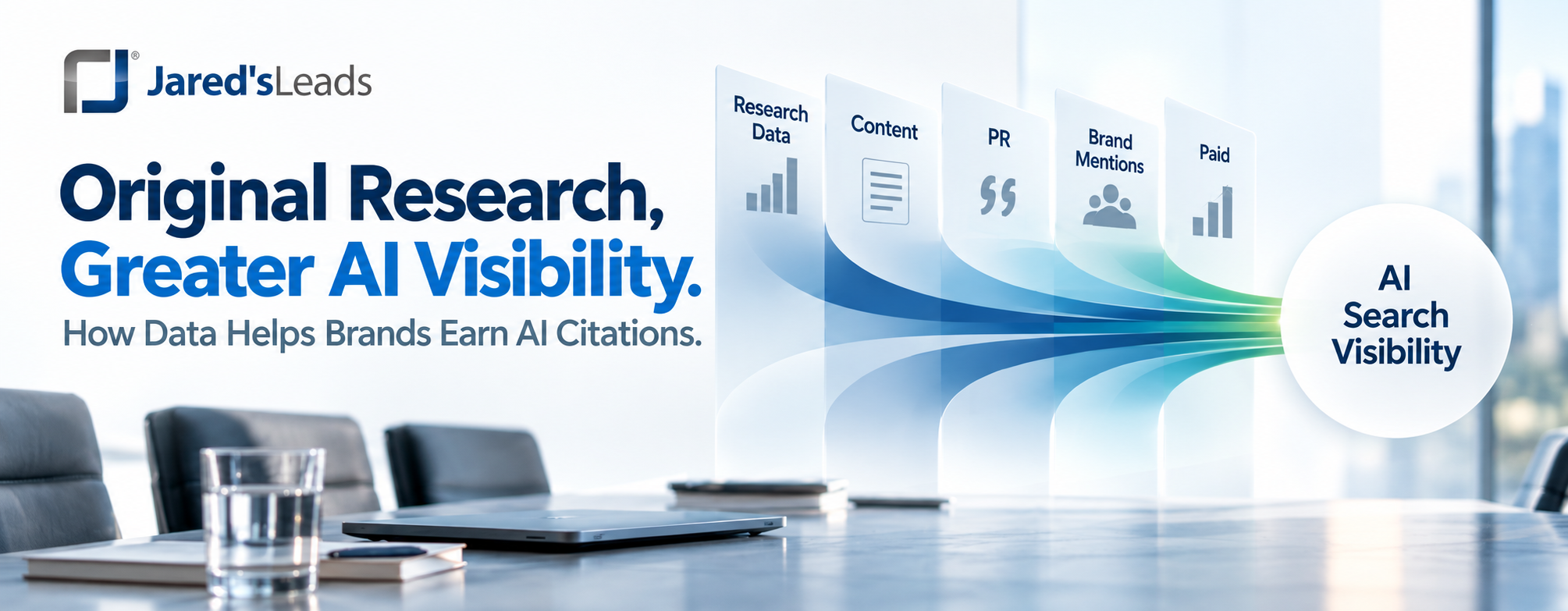
Jared’s Leads approaches LLM SEO through a five-stage framework that includes discovering the questions people ask, organizing the website around clear architecture and entities, creating original content, promoting the business through mentions and citations, and measuring AI visibility over time. This provides a useful framework for businesses that want entity SEO to contribute to an actual visibility strategy rather than exist as an isolated technical exercise.
The process can begin with understanding how the business currently appears in AI search. What happens when potential customers ask about the company’s primary service? Which competitors are mentioned? What sources are cited? Is the company described accurately? Does it appear for broad category questions but disappear when the question becomes more specific and commercial?
Those questions can reveal gaps that traditional SEO reporting may not show.
From there, Jared’s Leads can help businesses work on areas such as entity development, AI-focused content, structured information, citation opportunities, authority building, and ongoing visibility measurement. The company’s current LLM SEO service specifically highlights AI visibility audits, entity building, authority profiles, content optimization, and ongoing AI visibility improvements.
For businesses that want to understand the level of work involved, the LLM SEO packages provide a starting point for reviewing the available service structure. Businesses can also contact Jared’s Leads to discuss their current AI visibility, target audience, and the areas where their digital footprint may need improvement.
The objective should not simply be to make a company appear more often. The objective is to make sure that when an AI system encounters the company, it has enough accurate, relevant, and consistent information to understand what the business actually does and where it fits within the customer’s question.
Frequently Asked Questions About Entity SEO
Q.1. What is an entity in SEO?
An entity is a clearly identifiable subject such as a company, person, product, service, location, organization, or concept. Entity SEO focuses on helping search engines and AI systems understand those subjects and the relationships between them rather than relying exclusively on individual keywords.
Q.2. Is entity SEO the same as traditional SEO?
No. Entity SEO and traditional SEO overlap, but they are not identical. Traditional SEO focuses heavily on areas such as technical optimization, search intent, content, links, rankings, and organic traffic. Entity SEO adds greater emphasis on understanding the business itself, its attributes, relationships, expertise, and presence across the wider web.
Q.3. Why does entity SEO matter for AI search?
AI systems need to interpret questions in context. A buyer may describe a problem, industry, location, service requirement, and other qualifications within a single prompt. A clearly established entity footprint can provide more information that helps AI systems understand which businesses, services, and concepts are relevant to that question.
Q.4. Does schema markup create an entity?
Schema markup can help communicate information about an entity in a structured format, but it does not create authority by itself. A stronger entity presence generally comes from consistent business information, useful content, structured data, relevant external references, and credible authority signals working together.
Q.5. How can I measure entity SEO performance?
Entity SEO can be evaluated by monitoring how your company appears across search engines and AI platforms. Look at relevant buyer questions, brand mentions, competitor visibility, citations, descriptions of your company, and changes in visibility over time. Jared’s Leads’ AI visibility methodology emphasizes buyer-focused prompts rather than relying solely on generic searches.
Q.6. Can a small business benefit from entity SEO?
Yes. A small business does not need hundreds of pages or thousands of online profiles to establish a clearer entity footprint. It can start by making its core business information accurate and consistent, clearly explaining its services and expertise, publishing useful content, maintaining relevant profiles, and building legitimate authority within its market.
Final Takeaway

Entity SEO is ultimately about making your business easier to understand.
Traditional SEO taught businesses to think heavily about keywords, rankings, traffic, and clicks. Those fundamentals remain important, but AI search introduces another layer. When a customer asks an AI system a detailed question, the system needs to understand the business behind the words. It needs to know what the company does, who it serves, what services it provides, what subjects it has expertise in, and how those different pieces connect.
That understanding does not come from one page or one optimization technique. It develops from the combined information available across the company’s website, content, structured data, profiles, citations, publications, and other credible sources.
A strong entity strategy therefore starts with clarity. Define the business accurately. Explain the services properly. Establish the relationships between the company, its people, products, services, industries, and areas of expertise. Create content that answers genuine customer questions instead of simply chasing keywords. Keep important business information consistent across the web. Build legitimate authority in relevant places. Then monitor how AI systems actually represent the brand.
That is the foundation for becoming easier for AI to understand.
And as AI becomes a larger part of how people research companies, products, and services, businesses will need to think beyond simply asking whether they rank for a keyword. They will also need to ask whether AI understands what they are, what they do, and why they are relevant.
That is where entity SEO fits into the larger LLM SEO picture. It is not a replacement for traditional SEO. It is another layer of making your digital presence clearer, more connected, and more useful to the systems increasingly involved in how customers discover information.