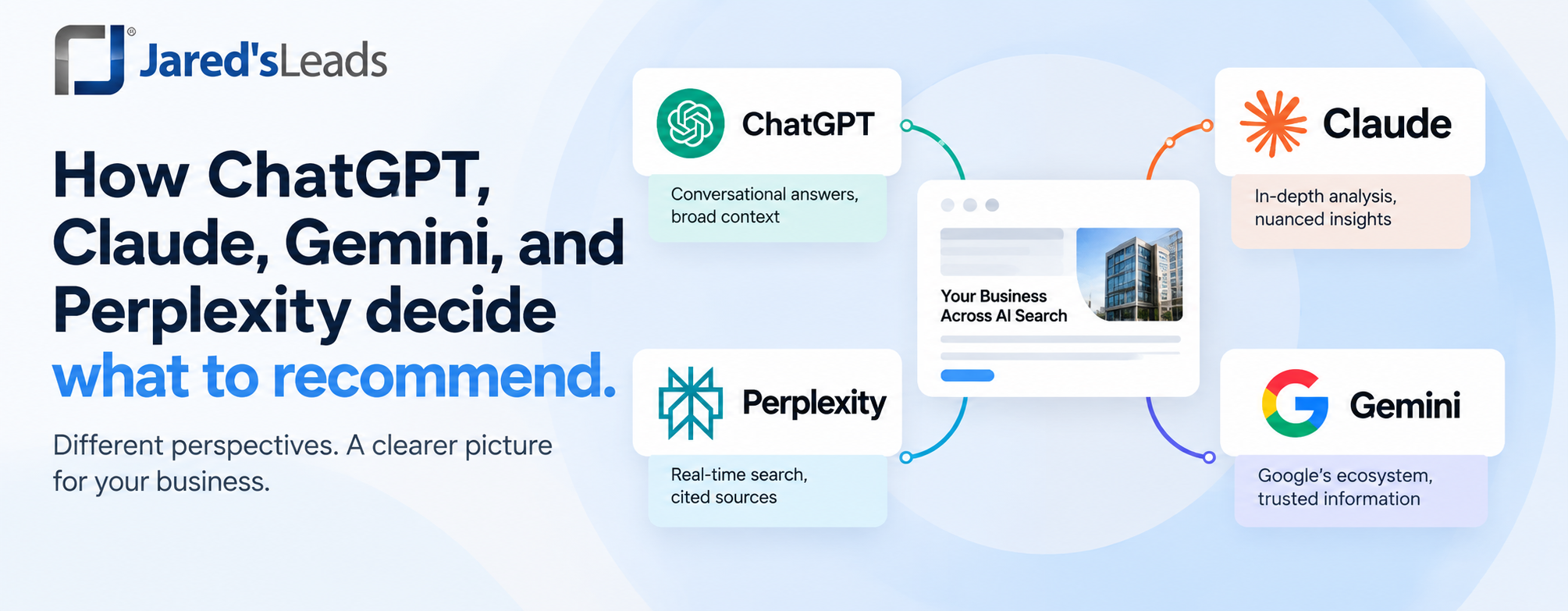
AI search is no longer one experience.
A buyer can ask ChatGPT, Claude, Gemini, or Perplexity the same question and receive different companies, different sources, and sometimes a completely different explanation of what matters. That does not necessarily mean one system is wrong. These products have different retrieval systems, product features, available context, and ways of presenting information.
For businesses, this creates a new GEO challenge. It is not enough to ask whether your company appears in AI search. You need to understand where it appears, what information supports that appearance, which sources the AI system can find, and how your visibility changes when the buyer’s question becomes more specific.
OpenAI, Anthropic, Google, and Perplexity’s exact formulas are proprietary and can change over time. No outside marketer can honestly publish a permanent formula explaining exactly why one company is selected over another. What we can study are the documented capabilities of these products, their observable search behavior, and the practical signals businesses can strengthen. Neil Patel’s recent platform-by-platform GEO analysis makes the same important distinction between what is documented and what remains proprietary.
This is where the modern approach to LLM SEO at Jared’s Leads becomes important. The objective is not simply to rank a page. It is to build an information environment that makes a business easier for AI systems to understand, verify, and potentially recommend.
Why AI Search Is Not One Search Engine

Traditional SEO encourages marketers to think in terms of keywords, rankings, pages, backlinks, and clicks. AI search changes the shape of that journey. A customer may ask a conversational question, continue with follow-up questions, ask for comparisons, or request a recommendation based on a very specific situation.
ChatGPT can search the web when current information is needed and provide links to sources. Perplexity describes its search process as conducting multiple searches across the web and synthesizing information from a range of sources with direct citations. Gemini can also provide sources and related links within its responses. These are not identical search experiences.
That difference matters when a customer asks something like, “What are the best lead generation companies for healthcare businesses?” The system needs more than a page containing the phrase “healthcare lead generation.” It may need information about industries served, use cases, data quality, targeting options, reputation, evidence, and current information before producing a useful recommendation.
This is why GEO should be approached as an information and authority strategy rather than a simple keyword exercise. The goal is to make your business understandable, verifiable, and relevant across the questions buyers actually ask.
Jared’s Leads takes a similar view through its broader LLM SEO approach, which combines entity authority, semantic coverage, structured content, E-E-A-T signals, and cross-platform authority rather than treating each element as an isolated SEO task.
Why ChatGPT, Claude, Gemini, and Perplexity Can Give Different Answers

There is a common assumption that if four AI platforms receive the same prompt, they should identify the same companies. In practice, these products don’t work that way.
They can have different access to current web information, different retrieval behavior, different product contexts, and different ways of synthesizing information.
Perplexity describes Pro Search as a process that can conduct multiple web searches, draw from articles, academic papers, forums, videos, and other sources, and then synthesize those findings into an answer with direct citations. OpenAI describes ChatGPT search as a way to pull current information from the web and provide relevant sources. Gemini may show sources and related links within its answers.
The practical lesson is not that a business needs four completely separate SEO strategies. Instead, you need a strong GEO foundation that works across multiple information environments, while also understanding where your weaknesses are on each platform.
| AI Platform | Practical GEO Focus |
| ChatGPT | Conversational buyer questions, useful context, current web sources, and follow-up relevance |
| Perplexity | Fresh retrieval, verifiable claims, original information, and strong source support |
| Claude | Clear context, depth, structured explanations, and demonstrated expertise |
| Gemini | Entity clarity, structured information, and consistency across the Google ecosystem |
These are strategic observations, not published ranking formulas. The platforms continually evolve, and their internal selection mechanisms are not fully public.
For businesses beginning this work, the first step is understanding how your existing digital presence performs. The Jared’s Leads AI Visibility and LLM SEO resources provide the foundation for looking at AI visibility as a broader business problem rather than simply another keyword ranking exercise.
How AI Systems Decide What to Say

It helps to think about AI answers in three broad layers.
First, there is the underlying model, which has been trained to understand language and generate responses. Second, there is the instruction and preference layer that shapes how the system responds to different requests. Third, there is the product layer, which may retrieve outside information at the time of the question.
For GEO, that third layer is especially important because it is where businesses can influence the information environment an AI system can discover.
If an engine searches the web, the quality, relevance, freshness, and clarity of available sources become part of the information it can use. OpenAI explicitly describes ChatGPT search as a way to access current web information and cite sources. Perplexity describes its research process as searching across multiple sources and synthesizing those findings.
This also explains why there is no single “AI ranking factor.”
A page may be excellent but fail to answer the buyer’s specific question. A company may have strong website content but weak third-party authority. Another business may have less polished content but a much broader footprint across trusted sources.
AI systems can combine these signals differently depending on the task.
That is why the goal should not be to reverse-engineer one mysterious formula. The more practical goal is to build a business presence that contains enough useful, accurate, structured, and corroborated information to support different types of AI discovery.
For businesses interested in understanding how that broader visibility is measured, Jared’s Leads has also documented its approach to AI search visibility tracking, including buyer-focused prompts, platform differences, competitor visibility, and decision-stage gaps.
Perplexity: Make Your Information Easy to Verify

Perplexity is particularly important for businesses because its product is built around search and source transparency. Its documentation describes Pro Search as conducting multiple searches across the web, synthesizing information from diverse sources, and providing direct links to the original sources used.
That creates a clear practical implication for GEO.
Businesses should make important claims easy to verify.
This is where original data, statistics, research, customer evidence, case studies, and clearly attributable statements become valuable. A sentence such as “We are a leading provider of high-quality leads” gives an AI system very little concrete information to verify. A page that explains which industries are served, what types of leads are available, how targeting works, what data fields are included, and what evidence supports the service provides a much richer information source.
The difference is not simply about writing more content. It is about giving the content substance.
If you have conducted research, publish it. If you have meaningful statistics, explain where they came from. If you have customer results that can be publicly shared, document them clearly. If your company has a unique methodology, explain how it works rather than simply giving it a branded name.
Freshness matters too. If your company has changed its services, locations, pricing, products, leadership, or capabilities, those changes should be reflected consistently across important public sources. A business should not force an AI system to reconcile five different versions of what the company does.
This is also why an AI visibility audit from Jared’s Leads can be useful. The objective is to understand not simply whether a business is mentioned, but what information is available around the brand and where visibility gaps exist.
Claude: Give AI Enough Context to Understand the Business

Claude should not be treated as a black box with a secret checklist of content types that “rank.” A more useful approach is to look at the kinds of tasks the product is designed to handle and then consider what that means for the information businesses publish.
For complex businesses, context matters.
A strong business page should explain more than what a service is. It should explain who the service is for, which problems it solves, how the process works, what customers should consider before buying, what makes the solution different, and what evidence supports the claims.
This becomes particularly important for B2B companies with complex products and services. If a company simply says it provides “AI marketing solutions,” an AI system has to fill in too many gaps. If the company explains its target customers, use cases, implementation process, technology, outcomes, industries, limitations, and supporting evidence, the business becomes much easier to interpret.
This is also where real experience matters.
Case studies, original observations, named expertise, customer examples, and detailed explanations give an AI system more context than generic marketing copy. Businesses should not manufacture expertise. They should document the expertise they already have.
That approach aligns with the broader philosophy behind Jared’s LLM SEO strategy, which emphasizes semantic depth, E-E-A-T signals, structured content, entity alignment, and continuous content development.
ChatGPT: Build for the Complete Buyer Question

ChatGPT can search the web when current information is needed, and OpenAI says its search experience can use web sources and provide links to those sources.
That makes conversational coverage important.
A buyer may start with a broad question and then continue with questions about pricing, alternatives, reviews, implementation, industry fit, or specific use cases.
For a business, this means content should be useful beyond a single keyword.
Suppose someone searches for “B2B lead generation companies.” The next questions might be about whether the provider serves a particular industry, how leads are verified, whether lists can be filtered by job title, what geographic coverage is available, or how a provider compares with alternatives.
Your website should therefore answer the broader decision process.
This does not mean creating dozens of thin pages. It means building a connected information environment where core service pages, supporting resources, FAQs, case studies, and educational content answer different parts of the same customer problem.
Jared’s Leads has already explored this concept in its article on ChatGPT query fanouts. A query fanout can involve several related information needs surrounding the original question. The practical implication is that businesses need to think about the complete buyer journey rather than optimizing a single page for a single phrase.
Gemini: Strengthen Entities and Structured Information

Gemini deserves a different tactical discussion because of its connection to Google’s broader ecosystem.
Google documents that Gemini Apps can surface sources and related links, including public websites and, where connected, Google Workspace content.
For public-facing businesses, this makes consistency and entity clarity particularly important.
An AI system should be able to distinguish your company from similarly named businesses and understand the relationships between your organization, services, products, people, locations, and areas of expertise.
Structured data can support this broader effort by providing machine-readable information about entities and page content. It does not mean schema markup automatically makes a business appear in Gemini recommendations. There is no public formula supporting such a claim.
The practical point is simpler: structured information can reduce ambiguity and help search systems interpret what a page and its associated entities represent.
A business should therefore look for consistency across its website, Google properties, professional profiles, directories, publications, and other authoritative sources. The company name, services, descriptions, locations, leadership information, and other important facts should not contradict each other.
For companies that want to evaluate how these signals fit into a broader LLM SEO strategy, Jared’s Leads’ LLM SEO service approach brings together structured information, entity optimization, content depth, and authority signals.
One Website Is Not Enough

A strong website is foundational, but AI systems do not necessarily limit themselves to company-controlled pages.
Search products can retrieve information from publishers, directories, forums, reviews, academic sources, videos, and other third-party environments. Perplexity explicitly describes retrieving information from diverse source types, while ChatGPT search can provide links to web sources.
This means your AI visibility is partly shaped by your wider digital footprint.
If your website says one thing but reputable third-party sources describe the company differently, an AI system may have to reconcile the conflicting information. If competitors have more independent coverage, more useful reviews, or more authoritative mentions, they may have a larger body of evidence available to an AI system.
The answer is not to manufacture reviews, create fake discussions, or flood the web with low-quality mentions.
The stronger approach is to earn legitimate visibility. Publish original research, contribute useful expertise, build real customer proof, maintain accurate business profiles, pursue relevant digital PR, and make sure important company information is consistent.
This broader authority model fits Jared’s Leads’ LLM SEO philosophy, which combines entity signals, content depth, third-party validation, structured information, and ongoing optimization.
What Changes Across the Four AI Engines?

The four platforms should be viewed as different environments rather than four versions of the same search engine. The following table summarizes the practical emphasis without pretending to reveal proprietary algorithms.
| Engine | What Businesses Should Emphasize |
| ChatGPT | Complete conversational answers, buyer-focused content, supporting pages, current information, and clear follow-up context |
| Perplexity | Original information, citations, statistics, current facts, and pages that make claims easy to verify |
| Claude | Detailed context, strong explanations, real expertise, case studies, and logically structured information |
| Gemini | Entity consistency, structured data, clear relationships, and accurate information across relevant Google-connected properties |
The important point is that these recommendations overlap.
A company should not create one website for ChatGPT and another for Perplexity. The underlying information should be strong everywhere. The platform-specific analysis simply tells you which gaps deserve additional attention.
This is one reason Jared’s Leads approaches AI visibility as an ongoing process rather than a one-time optimization project. The Jared’s Leads AI visibility resources can serve as the starting point for understanding how these different visibility signals fit together.
How to Measure GEO by Engine

Traditional rank tracking gives you a position for a keyword. AI visibility is more complicated because an answer may mention several companies, cite several sources, or change depending on the wording and context of the prompt.
That means businesses need a broader measurement framework.
Start by tracking brand mentions and citations across the platforms that matter to your audience. Then examine whether your brand appears for broad informational questions, problem-specific questions, comparison queries, and decision-stage prompts.
This is more meaningful than running one generic prompt once a month.
Source diversity is another useful metric. If competitors repeatedly appear as cited sources while your company appears only through its own website, that tells you something about the strength of your external authority.
Consistency also matters. If the same buyer-focused prompt produces your brand in one test and omits it in several others, the result may point to a visibility gap that deserves investigation.
Jared’s Leads’ existing visibility methodology separates primary metrics such as visibility and brand share from deeper measures such as topic gaps, consistency, platform differences, and competitor visibility gaps. That approach treats GEO as a diagnostic process rather than a single score.
For businesses looking to investigate those gaps, the Jared’s Leads AI Visibility Audit is designed around understanding how a brand appears across AI and search environments rather than looking only at traditional rankings.
What Businesses Should Actually Do

The first step is to identify the buyer questions that matter most.
Instead of beginning with a list of keywords, start with the people who buy your product or service. What problem are they trying to solve? What makes them compare providers? What questions do they ask before contacting sales? What objections slow the decision? What evidence do they need before trusting a company?
Next, test those questions across ChatGPT, Claude, Gemini, and Perplexity.
Record which companies appear, which sources are cited, what attributes are associated with each company, and which competitors appear when your brand does not. This creates a practical baseline.
The next stage is to strengthen the information gaps. Improve service pages that lack detail. Add evidence where claims are unsupported. Publish original research where you have something useful to contribute. Build supporting content around real buyer questions. Improve structured data and entity consistency. Then strengthen legitimate third-party visibility.
Finally, rerun the same buyer-focused prompts regularly.
AI search changes quickly, and a strategy that works today should be measured again rather than treated as permanent. The goal is not to chase every algorithm change. It is to identify where your business is understood, where it is missing, and what information or authority signals may explain the difference.
A practical 30-day GEO process can be organized into four stages:
| Stage | What to Do |
| Week 1 | Audit current visibility across the four platforms |
| Week 2 | Map buyer questions, problems, intents, and qualifiers |
| Week 3 | Strengthen website content, entities, structured information, and authority signals |
| Week 4 | Retest the same prompts and identify changes, gaps, and competitor movement |
This turns GEO from a vague marketing concept into an ongoing measurement and improvement process.
How Jared’s Leads Can Help

Jared’s Leads approaches AI visibility as a business visibility problem rather than simply a content production exercise.
The starting point is understanding what buyers actually ask and then measuring how the brand appears when those questions are presented to AI platforms.
The process can include building buyer-focused prompt clusters, testing them across multiple AI systems, identifying competitors that appear instead, analyzing the sources that influence the answers, identifying missing content and entity signals, strengthening first-party and third-party authority, and tracking changes over time.
This approach is particularly useful for companies that already have traditional SEO but are seeing a new problem: their website ranks, yet AI systems do not consistently mention or recommend the brand when buyers ask for solutions.
Jared’s Leads combines traditional SEO foundations with LLM SEO, entity optimization, structured information, authority building, and AI visibility measurement. The company’s LLM SEO approach specifically focuses on making brands easier for AI systems to recognize, understand, and associate with the subjects and solutions that matter to their customers.
If you want to understand where your brand currently appears across AI search, you can request an AI Visibility Audit from Jared’s Leads. The objective is to turn the audit into specific actions rather than another generic report.
FAQs
Q.1 Do ChatGPT, Claude, Gemini, and Perplexity use the same ranking algorithm?
No. The four products share some broad foundations in modern AI development, but their product architectures, retrieval systems, available context, and search experiences differ. The exact formulas used to select or synthesize information are proprietary and can change. That is why businesses should measure their visibility across multiple platforms rather than assuming performance in one automatically transfers to another.
Q.2 Does GEO require different content for every AI platform?
Not usually. The better approach is to build a strong core information foundation that is useful across platforms, then identify platform-specific gaps. A detailed service page, original research, clear entity information, useful FAQs, and legitimate third-party references can support visibility across multiple AI systems. Platform testing helps determine where additional work may be needed.
Q.3 Does schema markup guarantee AI visibility?
No. Structured data can make information more machine-readable and help search systems interpret entities and page content, but it does not guarantee that an AI system will cite or recommend a business. Schema should be treated as one part of a broader strategy that includes useful content, entity clarity, authority, technical SEO, and consistent information.
Q.4 Why does my business appear in one AI platform but not another?
Different platforms can retrieve different sources, interpret prompts differently, and have different product-level search behavior. Your business may have strong signals in one information environment and weaker signals in another. Testing the same buyer-focused prompts across platforms can help identify whether the gap is related to content coverage, third-party authority, freshness, entity clarity, or the platform’s particular retrieval behavior.
Q.5 How can I measure whether GEO is working?
Track more than mentions. Measure brand visibility, citation frequency, source diversity, consistency across repeated prompts, competitor visibility, and performance at different buyer-intent stages. Most importantly, connect those visibility measurements to business questions. If the goal is lead generation, decision-stage visibility is generally more useful to monitor than broad category visibility alone. Jared’s Leads’ existing AI visibility methodology uses this broader approach to distinguish basic visibility from deeper buyer-focused gaps.
Final Takeaway
ChatGPT, Claude, Gemini, and Perplexity are not four identical versions of Google. They operate in different product environments, retrieve and present information differently, and can produce different recommendations from the same question.
The exact formulas behind those recommendations are proprietary, so businesses should be cautious about anyone claiming to know a permanent AI ranking recipe.
What businesses can control is the quality of the information available about them.
Make your services clear. Answer the questions buyers actually ask. Support important claims with evidence. Publish information that others can verify. Strengthen your entity and structured data signals. Build legitimate third-party authority. Then test your visibility across the AI platforms your customers use.
GEO is becoming less about trying to optimize for one mysterious AI algorithm and more about building a digital presence that is clear, useful, credible, and easy for multiple AI systems to understand.
When you measure that presence by engine, source, competitor, and buyer intent, you can see not only whether your brand is being mentioned, but where the gaps are and what you can do about them.
And that is the real shift in AI search.
You are no longer optimizing only for where your website ranks. You are optimizing for whether AI understands why your business belongs in the answer.