Key Takeaways
- Most AI visibility tracking methods generate data that seems relevant but is not, since the prompts given to the AI do not take into account the way buyers actually search for information within AI systems.
- The BPIQ framework (Buyer, Problem, Intent, Qualifier) incorporates client data and structures the prompts in a way that converts visibility tracking requests from AI systems to a more reliable buyer proxy.
- When prompts are given based on actual buyers, the variation among AI systems is informative signals, not the noise that cannot be explained.
- Measurement has two layers superficial metrics provided by tracking systems and a second layer of metrics calculated to show competitive conditions and the degree to which metrics are stable.
- This naturally aligns visibility tracking with relevant business results since it becomes much more difficult to justify the tracking of irrelevant, low-quality queries that do not reflect the actual purchase-deciding process of your clients.
- Decision-stage visibility gaps among general category AI search results is the most important issue for healthcare clients, wellness brands, and high-value service businesses, even when they see robust visibility in general category AI search results.
Most businesses measuring AI search visibility are tracking the wrong metrics.
A common mistake is relying on broad, generic prompts such as “best wellness provider,” “top lead generation company,” or “healthcare marketing services.” While these queries may generate results, they rarely provide meaningful insight into how potential customers actually discover your business through AI search. As a result, even if your brand appears in the responses, the data often lacks the context needed to make informed marketing decisions.
The issue isn’t the AI tracking platform, it’s the prompts being used. Generic queries don’t reflect real buyer intent, the questions prospects actually ask, or the specific scenarios that lead to purchasing decisions. Because of this, the results can be misleading and offer only a broad view of your AI visibility.
In this article, we’ll explain why we changed our approach to measuring AI visibility, how we refined our lead generation strategy, and the improvements we made to our tracking system to produce insights that are more accurate, actionable, and aligned with real customer behavior.
Why the Old Tracking Approach Wasn’t Working
The first generation of AI visibility tracking borrowed heavily from traditional SEO rank tracking. Businesses created a list of search queries, ran them across multiple AI platforms, tracked the responses, and compared the results over time.
With traditional search, this approach works well. A query like “Who is the best healthcare marketing company?” has the same intent regardless of who asks it. Google returns a ranked list of websites, making it easy to monitor changes in rankings.
AI search works differently. Responses are generated using available context, or sometimes no context at all, which means the same query can produce different answers each time. When prompts are vague or lack context, AI generates responses for a hypothetical user rather than someone who closely matches your ideal customer.
As a result, the data may look useful, but it doesn’t accurately reflect your brand’s visibility among healthcare executives, wellness business owners, or buyers of high-ticket services who are actively evaluating providers.
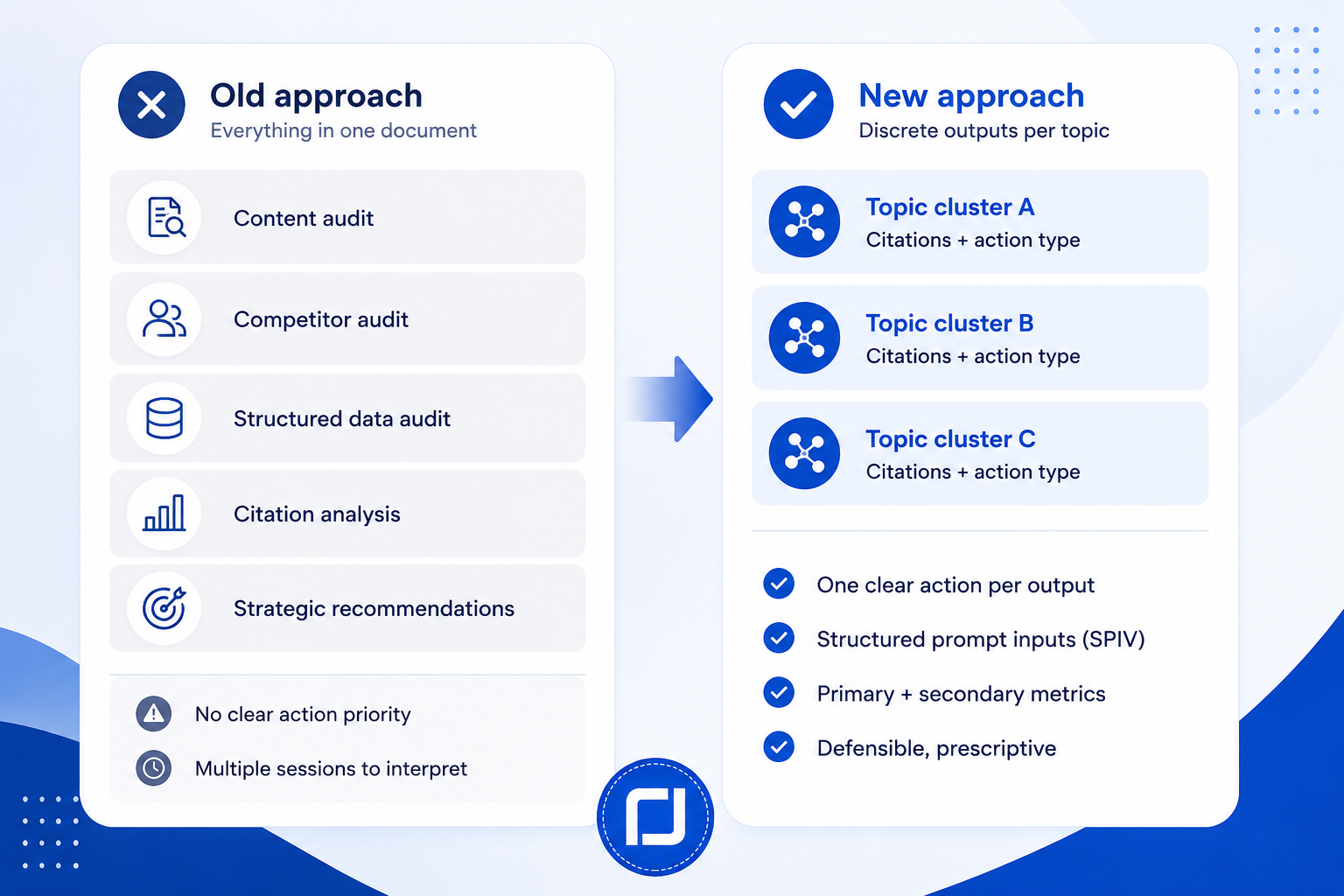
This created two connected problems. The first was measurement. Generic prompts measured fictional buyers instead of real ones. The second was reporting. When visibility changed, there was rarely a clear explanation or practical guidance on what caused the change or how to respond. Rankings shifted, but there was little evidence linking those changes to content updates, PR efforts, or competitor activity.
Both of these challenges were addressed in the rebuild. To improve measurement, we developed the BPIQ framework. To improve visibility tracking, we shifted to segmented analysis, measuring different buyer intents instead of relying on a single overall visibility score.
Introducing the BPIQ Framework
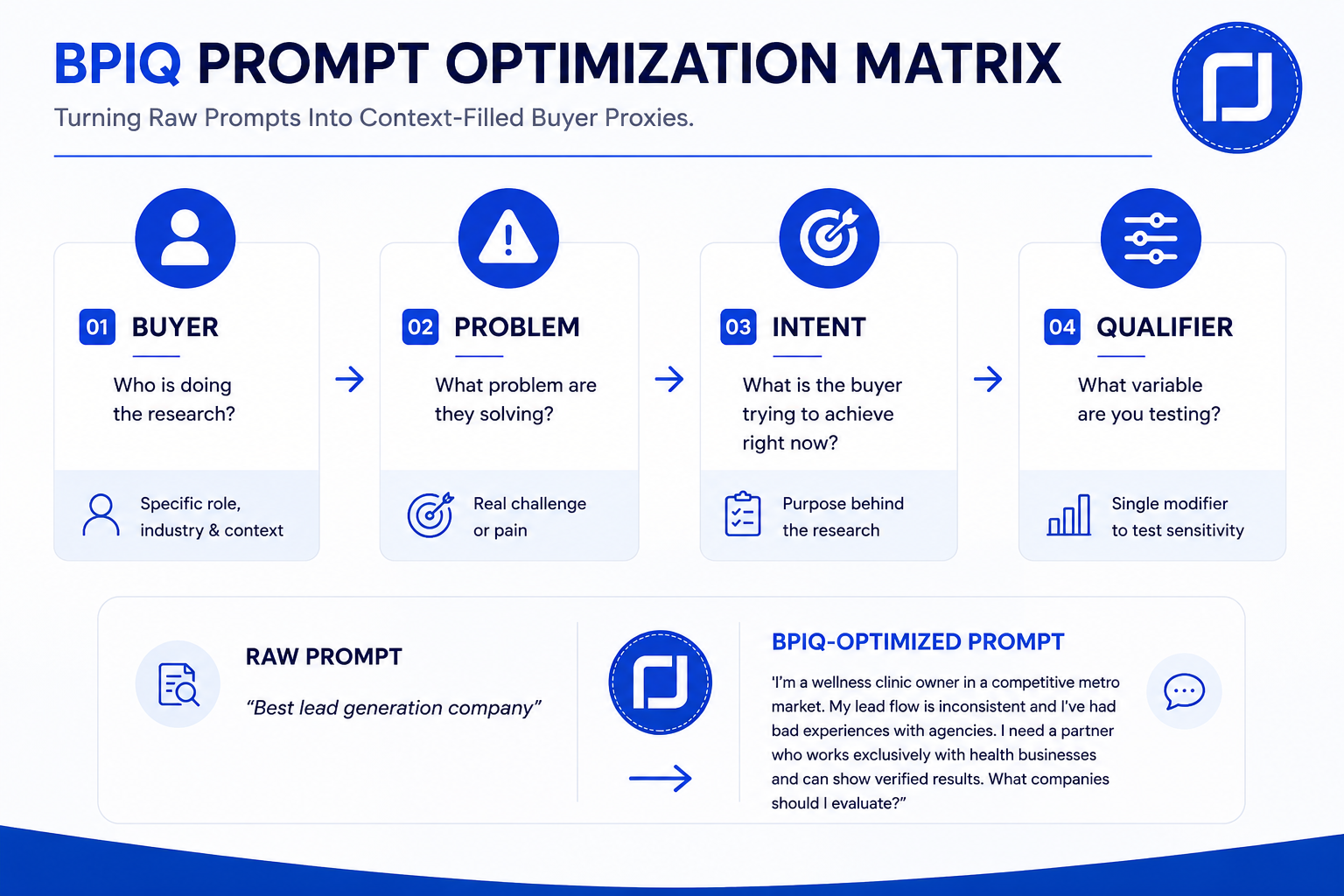
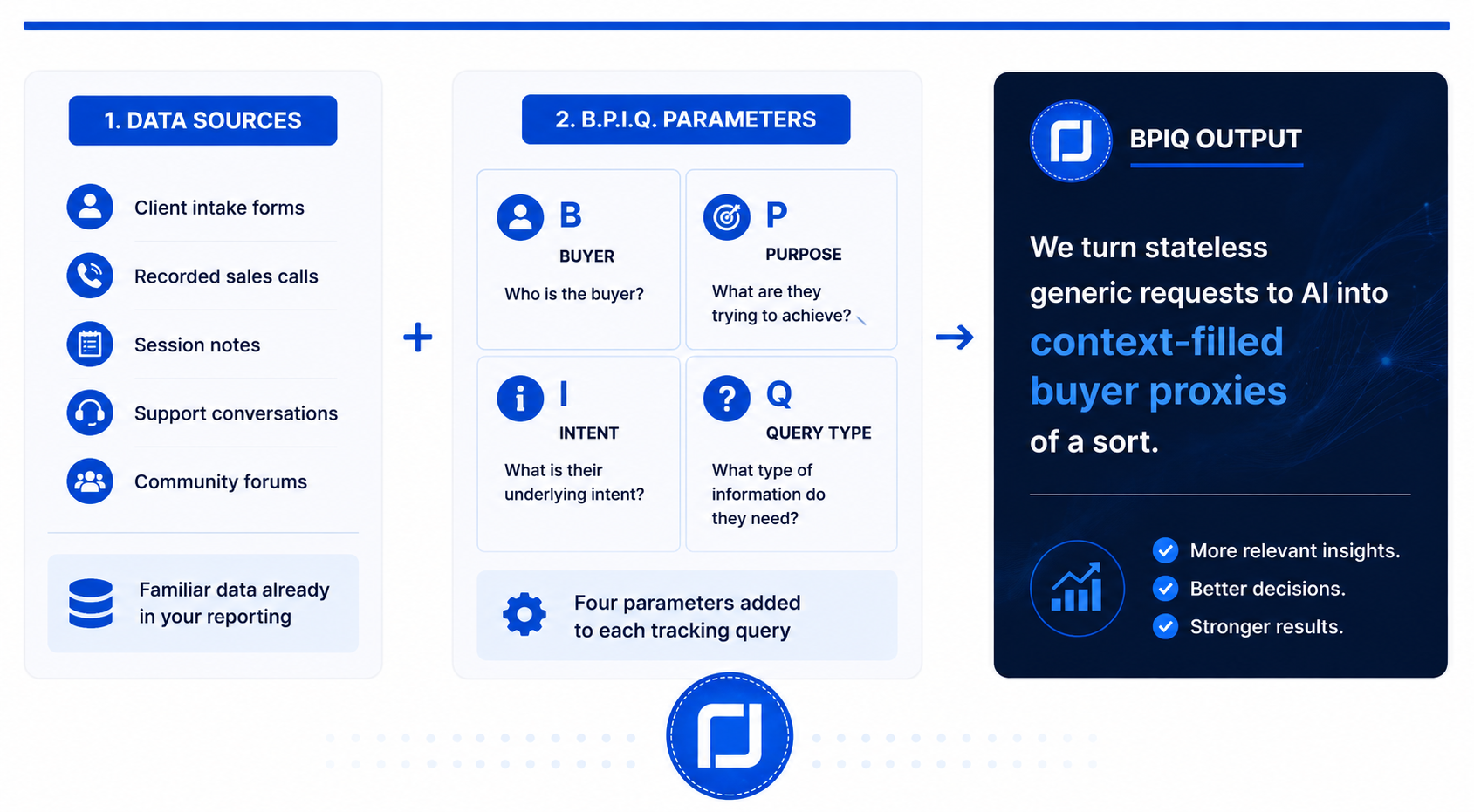
The BPIQ framework is built on data that most businesses already collect. Client intake forms, sales call recordings, consultation notes, support conversations, and discussions within industry communities all contain valuable customer insights. The difference lies in how that data is used.
Instead of relying on generic search prompts, BPIQ structures every tracking query around four key parameters. This transforms broad, context-free AI requests into realistic buyer profiles that more closely reflect how actual prospects research products and services.
Each BPIQ variable serves a specific purpose, helping transform generic AI queries into prompts that better reflect how real buyers conduct research.
- Buyer:
The buyer represents the specific person conducting the research, including their role, industry, and business context. For example, “Healthcare practice owner evaluating lead generation providers” is a well-defined buyer. In contrast, “Business owner” is too broad to provide meaningful insights. The more specific the buyer profile, the stronger and more reliable the measurement. - Problem:
This defines the challenge the buyer is trying to solve, not simply the topic they’re searching for. For example, “Struggling to fill appointment slots despite running Google Ads” is a clear problem statement. “Looking for marketing help” is too generic. Specific problems provide AI with meaningful context, leading to more accurate and relevant responses. - Intent:
Intent explains why the buyer is researching at that particular moment. They may be building an internal business case, comparing shortlisted vendors, or preparing to make a purchasing decision. Even when the buyer and problem remain the same, different intent signals can produce very different AI recommendations. - Qualifier:
Qualifiers introduce specific priorities that influence purchasing decisions. Modifiers such as “fastest results,” “most compliant,” or “lowest upfront cost” can be applied to the same buyer and problem to measure how AI responses change. Testing one variable at a time makes it much easier to understand which factors are influencing visibility.
A focused set of 20 to 35 BPIQ-structured prompts, built around real buyer segments and genuine purchase intent, produces far more meaningful insights than hundreds of generic search queries. The goal isn’t to create more prompts. It’s to create representative prompts that accurately reflect how your ideal customers evaluate solutions.
The table below illustrates how generic AI queries can be transformed into BPIQ-structured prompts that deliver more actionable visibility data.
| Raw Prompt | BPIQ-Optimized Prompt |
| “Best lead generation company” | “I’m a wellness clinic owner in a competitive metro market. My current lead flow is inconsistent and I’ve had bad experiences with agencies that promised results and delivered low-quality contacts. I need a lead generation partner who works exclusively with health businesses and can show me verified performance history. What companies should I evaluate?” |
| “Healthcare marketing services” | “I run a mid-sized chiropractic practice and I’m trying to reduce my dependence on paid ads because costs have doubled in two years. I want to understand which marketing approaches are actually working for practices like mine right now specifically ones that generate recurring patients, not one-time visitors.” |
The raw prompt describes no one, and the BPIQ optimized prompt describes a specific person about whom the prompt answers a specific, measurable question. This is what makes the BPIQ measurement input.
The Two Layers of Measurement: Primary and Secondary Metrics
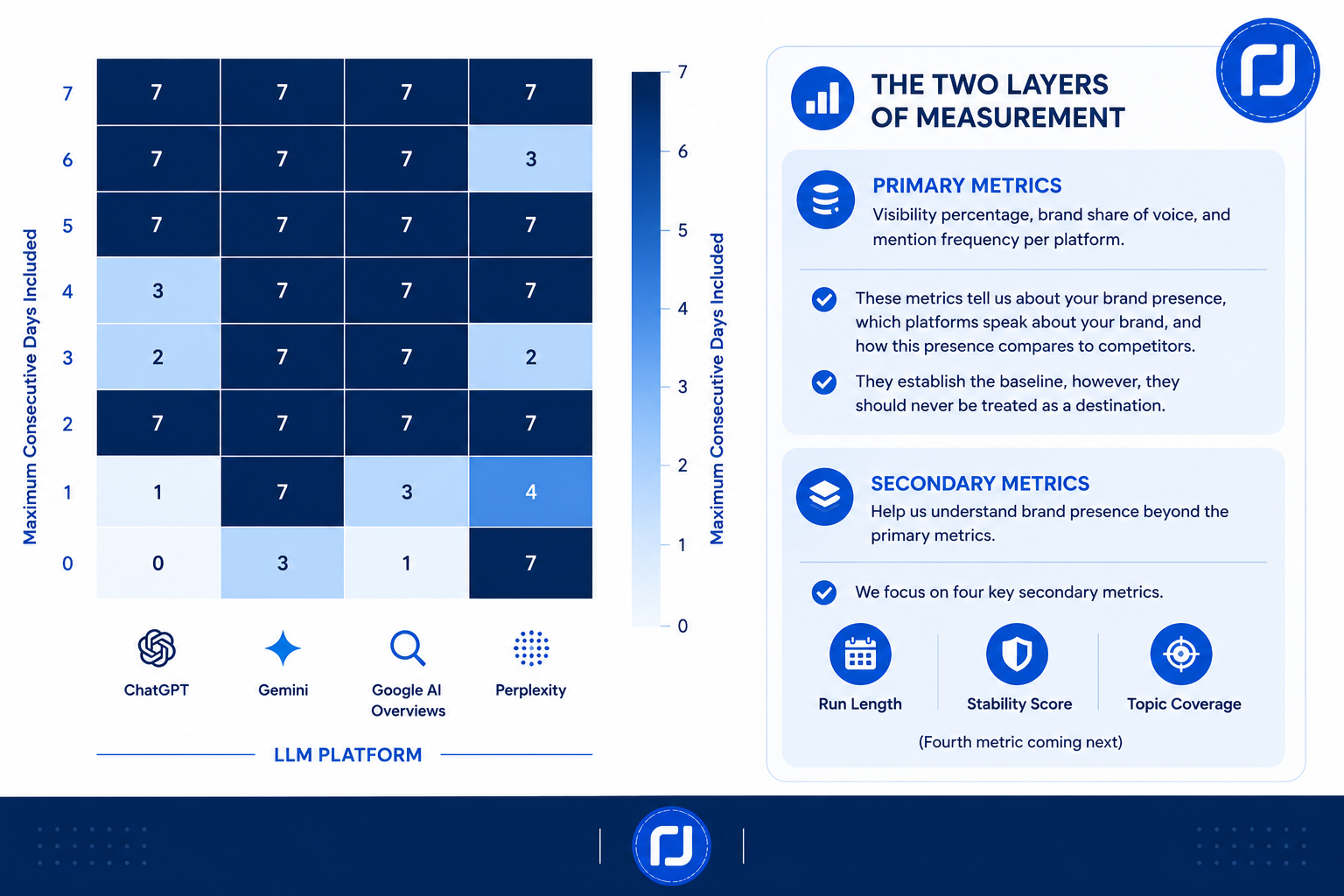
The first layer consists of primary metrics, including visibility percentage, brand share of voice, and mention frequency across AI platforms. These metrics measure how often your brand appears, which platforms reference it, and how your visibility compares with competitors. While they provide an important baseline, they should be viewed as a starting point rather than the final measure of success.
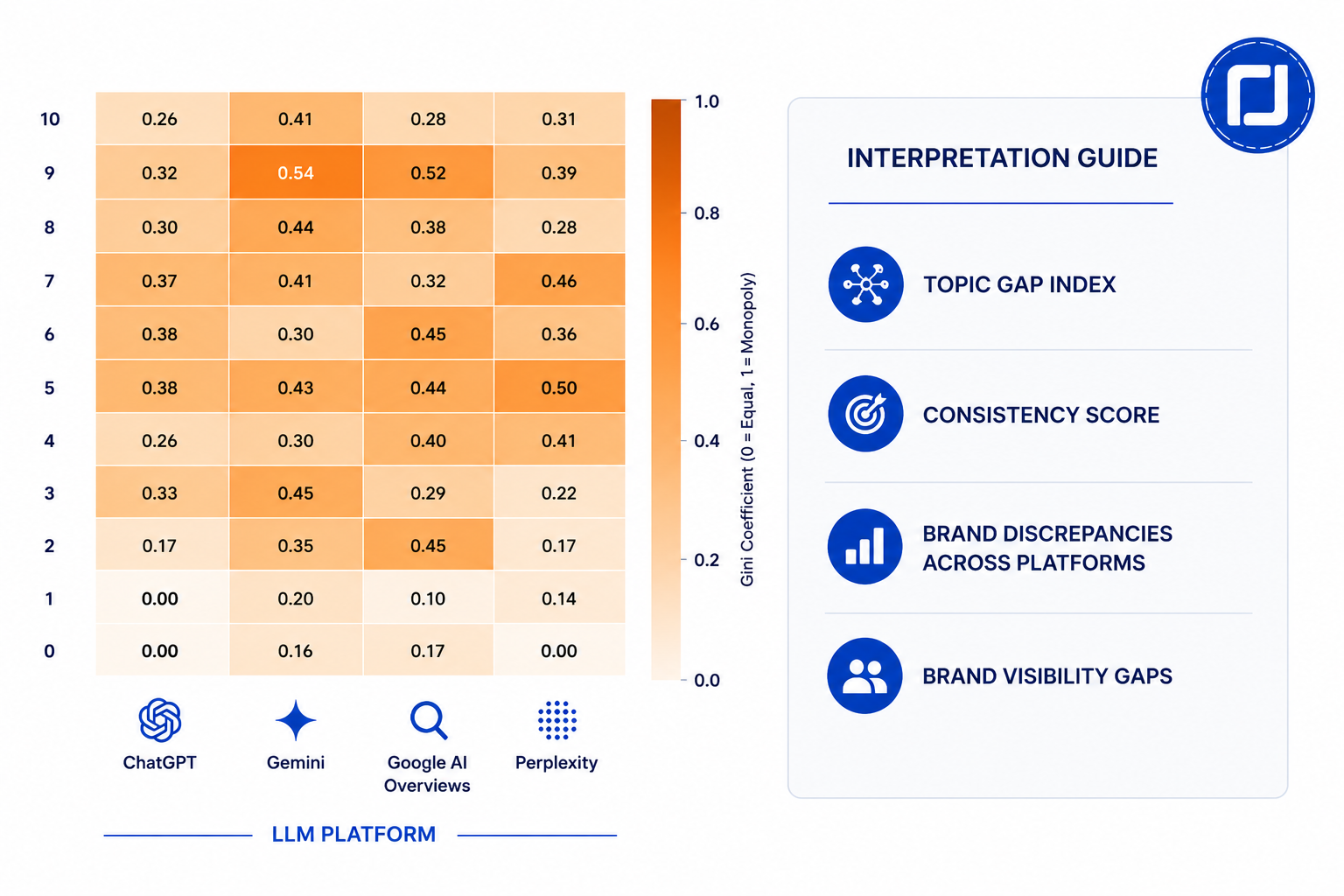
The second layer focuses on secondary metrics, which provide deeper insight into why your visibility changes and where improvements are needed. We track four key secondary metrics, three of which are outlined below.
Topic Gap Index:
This metric measures the difference between your brand’s visibility in broad, informational queries and high-intent, decision-stage searches. It is often one of the most valuable indicators of AI visibility. Many brands perform well in general research queries but see a significant drop in visibility when AI platforms respond to buyers who are actively comparing providers or preparing to make a purchase. Traditional visibility tracking often averages these results together, masking the gap and making it difficult to identify where improvements are truly needed.
Consistency Score:
How consistently does your brand appear when the same prompt is run multiple times? Consistency is a strong indicator of brand authority and trust within AI platforms. A brand that appears in a high percentage of repeated queries demonstrates stronger authority than one whose visibility is inconsistent. For example, if your brand is mentioned in 60% of repeated prompt executions, it signals a meaningful and measurable level of recognition.
Brand Visibility Across Platforms:
How does your brand perform across ChatGPT, Gemini, Perplexity, and Google AI Overviews? Looking only at aggregated visibility can hide important differences between platforms. Each AI system interprets user intent differently and may recommend different brands for similar queries. If your brand has little or no visibility on one platform, it represents a strategic weakness, even if your overall visibility appears strong. This becomes even more significant if your target audience primarily uses the platform where your brand is least visible.
Brand Visibility Gaps:
Which competitors appear when your brand doesn’t? Understanding who gains visibility in your absence is often more valuable than measuring your own visibility alone. It highlights the competitors earning stronger authority signals and provides direction for improving your own presence through better content, digital PR, and authority-building strategies. Identifying these gaps helps prioritize the actions that will have the greatest impact on increasing AI visibility.
What the Data Tells You
When BPIQ-structured prompts are combined with both primary and secondary metrics, AI visibility becomes much more than a single score. It provides a clear, diagnostic view of how your brand performs across different buyer journeys and AI platforms.
In practice, this approach consistently reveals three important insights that generic AI visibility tools often miss.
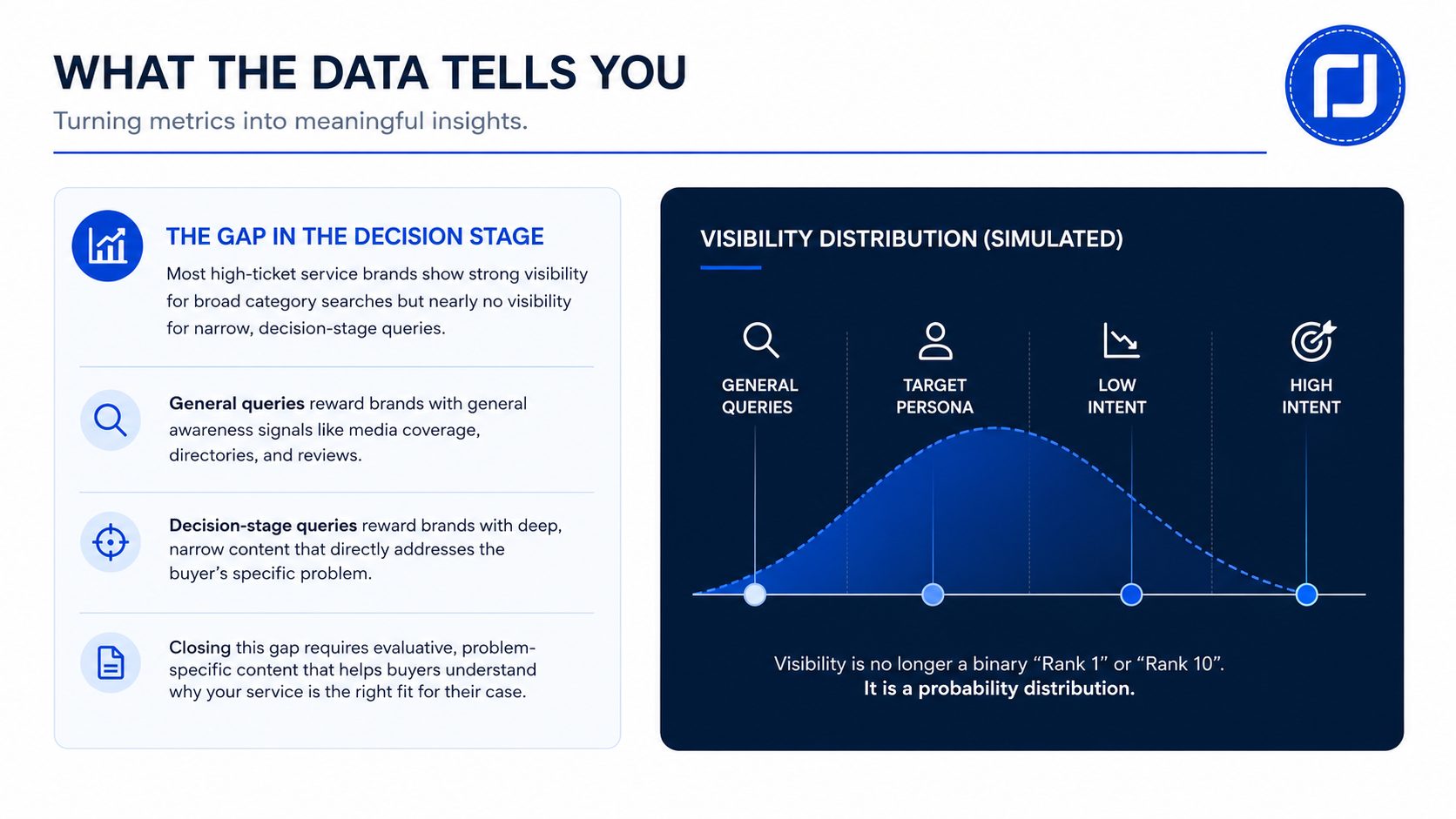
The Decision-Stage Visibility Gap
One of the most common findings in our audits for healthcare, wellness, and other high-ticket service businesses is a significant visibility gap between broad informational searches and high-intent, decision-stage queries. Many brands perform well for general category searches but have little or no visibility when buyers describe specific problems and begin evaluating providers.
This happens because broad queries reward general authority signals such as media mentions, directory listings, and online reviews. Decision-stage queries, however, favor businesses that publish detailed, problem-focused content designed to help buyers compare solutions and make informed decisions.
Closing this gap requires content that many businesses simply don’t have. Brands need resources that address the specific questions, concerns, and evaluation criteria buyers have when they are ready to choose a provider.
Platform-Specific Visibility Differences
It’s common to see brands perform well in Google AI Overviews while having limited visibility in ChatGPT or Perplexity, even for the same buyer scenario. This matters because people use AI platforms differently throughout their research process.
For example, a healthcare executive may use ChatGPT for detailed research before turning to Google AI Overviews to confirm key information. If your brand appears only during the verification stage but is missing during the initial research phase, you’re helping validate decisions rather than influencing them.
Understanding these platform-specific differences helps identify where your brand is being discovered, where it’s being overlooked, and where additional optimization is needed.
The Competitor Authority Map
Another valuable insight comes from identifying which competitors appear when your brand doesn’t. This reveals where competing brands have built stronger authority signals and earned greater AI visibility.
Rather than focusing only on the queries where your brand already performs well, this analysis highlights the buyer scenarios where competitors have an advantage. Those findings provide a clear roadmap for future content, digital PR, and authority-building efforts, helping you strengthen your presence where it matters most.
About Jared’s Leads
Jared’s Leads is a marketing and data company that helps businesses grow through smarter lead generation, precise audience targeting, and data-driven marketing systems. Founded in 2008 by entrepreneur Jared Knapp, the company has spent more than 15 years helping thousands of businesses build predictable pipelines with high-quality, high-intent leads that support long-term growth.
The BPIQ methodology outlined in this guide reflects the same philosophy behind every solution developed by Jared’s Leads. Rather than relying on broad market assumptions or generic benchmarks, every lead generation system, AI visibility framework, and content strategy is built around real buyer behavior, real market data, and the specific needs of each client’s ideal audience.
Unlike traditional data brokers that sell the same lead lists to multiple competing businesses, Jared’s Leads develops proprietary growth systems tailored to each client’s unique market and business objectives. These systems are backed by more than a decade of performance tracking, testing, and optimization across a wide range of industries. This data-driven approach has helped clients achieve measurable growth and contributed to businesses earning recognition on the Inc. Magazine Fastest-Growing Private Companies list in 2022, 2024, and 2025. In April 2026, Jared’s Leads reached another verified growth milestone, reinforcing its commitment to delivering accountable, measurable results for every client.
FAQs
How do you track AI search visibility for a brand?
The first step is creating a refined set of prompts that align to your actual buyer personas and the intent stage(s) that you are interested in tracking. Avoid the generic placeholders. Visually track the prompts you create via ChatGPT, Gemini, Perplexity, and Google’s AI overviews on a regular basis, and analyze key indicators such as visibility % and share of voice, alongside less important indicators such as consistency and divergence across platforms. The most notable insights will come from the disparity of visibility in traditional queries vs the visibility in prompts that are contextual as related to the buyer persona stage, rather than generic prompts.
What distinguishes AI visibility tracking from tracking SEO rankings?
Traditional rank tracking is effective because a keyword will translate consistently across different users, while Google will provide a consistent set of results per keyword. AI platforms are different. The same query can result in a different outcome depending on the persona, intent, and context provided (or in many cases, a complete lack of) within the prompt. Without the right framework to capture buyer intent, the results will be generic and will not reflect any meaningful engagement. However, when structured prompts are created with buyer personas in mind, the outcomes will provide insight on how the brand ‘shows up’ when it is actually relevant.
What is the significance of the gap between general visibility and decision-stage visibility?
The gap between general visibility and decision-stage visibility is significant because they measure different levels of visibility. If high visibility exists in broad category search queries, it means that an AI platform connects your brand with a specific category. However, if high visibility exists in decision-stage search queries, it means that an AI platform connects your brand with the context and constituent elements of a purchase decision. It is the latter that is pertinent to lead generation. If a brand displays strong general visibility while exhibiting weak decision-stage visibility, it means the brand is being ‘seen’ but not ‘chosen.’ Standard tracking fails to capture this.
Conclusion
The shift in AI visibility measurement is simple in concept but significant in impact. Instead of tracking rankings for generic, low-value queries, businesses can measure how consistently they appear for real buyers searching with genuine purchase intent.
The BPIQ framework provides the structure needed to build meaningful AI search prompts, while primary and secondary metrics help interpret the results. Together, they deliver a more complete view of AI visibility by revealing platform-specific performance, competitive positioning, consistency, and decision-stage visibility gaps. Rather than producing a single score, this approach generates actionable insights that businesses can use to strengthen their AI search presence.
Understanding where your brand appears is only the beginning. The real opportunity lies in identifying where visibility is missing and taking the right steps to close those gaps. For many businesses, this requires a content strategy and lead generation system that align with how buyers actually research and evaluate providers. That is where AI visibility becomes a competitive advantage instead of simply another reporting metric.
Start Tracking What Actually Matters with Jared’s Leads
Most businesses only measure their visibility using broad, generic search queries. Jared’s Leads helps businesses go beyond surface-level tracking by building AI visibility measurement frameworks based on real buyer intent, allowing you to understand how your brand appears across platforms such as ChatGPT, Google AI Overviews, Gemini, and Perplexity during the moments that influence purchasing decisions.
Backed by more than 15 years of lead generation expertise, thousands of successful client engagements, and recognition through multiple Inc. 5000 rankings, Jared’s Leads combines proven lead generation systems with AI visibility strategies that produce measurable business results.
Schedule your complimentary AI Visibility Assessment today and discover how your brand performs where it matters most. We’ll identify your visibility gaps, uncover new opportunities, and provide a clear roadmap to improve your presence across today’s leading AI search platforms.