Key Takeaways
- One major distinction separating users from traditional search engines is that ChatGPT does not present a dedicated results page with potential answers. In fact, if you’re not selected as one of a few names, there is no page two.
- ChatGPT does not verify your answer, as much as it verifies the credibility of your answer and the consensus across the Internet. It’s a lot about naming, and much less about performance.
- One raving review isn’t going to create a reputation, but consistent mentions across multiple platforms is highly valued.
- Pages that contain excessive descriptions of the same thing typically yield the same results when referenced by ChatGPT. Pages that contain narrow, concise answers are referenced far more frequently.
- Unsupported claims will be dismissed. If a model cannot verify a claim, it will likely either hedge the claim or omit it altogether.
- Claiming to be the first in a field doesn’t truly establish credibility. Provably being the first in a field matters more. If a website is the only source, longevity isn’t helpful.
- Where trust is most important, AI models appear to use the toughest standards. In these cases, vague promises are much less helpful.
- Winning a category means being the answer without the user needing to ask for a comparison. The goal is no longer a traffic win, but to have users land on your site without needing to ask for a comparison.
Not long ago, the typical way to find information online was to search on Google, scroll through multiple results, compare websites, and make a decision. Today, that behavior is changing rapidly.
More people are turning to AI assistants like ChatGPT and asking questions directly. Instead of browsing dozens of links, they often trust the assistant’s recommendation and move on.
This fundamentally changes how businesses are discovered. If an AI assistant mentions your brand, you’ve earned a valuable opportunity. But if your business isn’t included in the response, the user will likely never know you existed—they’ve already found what they were looking for.
In the era of LLM SEO, visibility isn’t just about ranking on a search engine. It’s about becoming one of the sources AI models trust and recommend. Because when AI gives the first answer, it often becomes the only answer that matters
Our real research focused on what names get suggested most often. From there, we reverse engineered what would put the right business name in the answer.
Who Does ChatGPT Recommend?
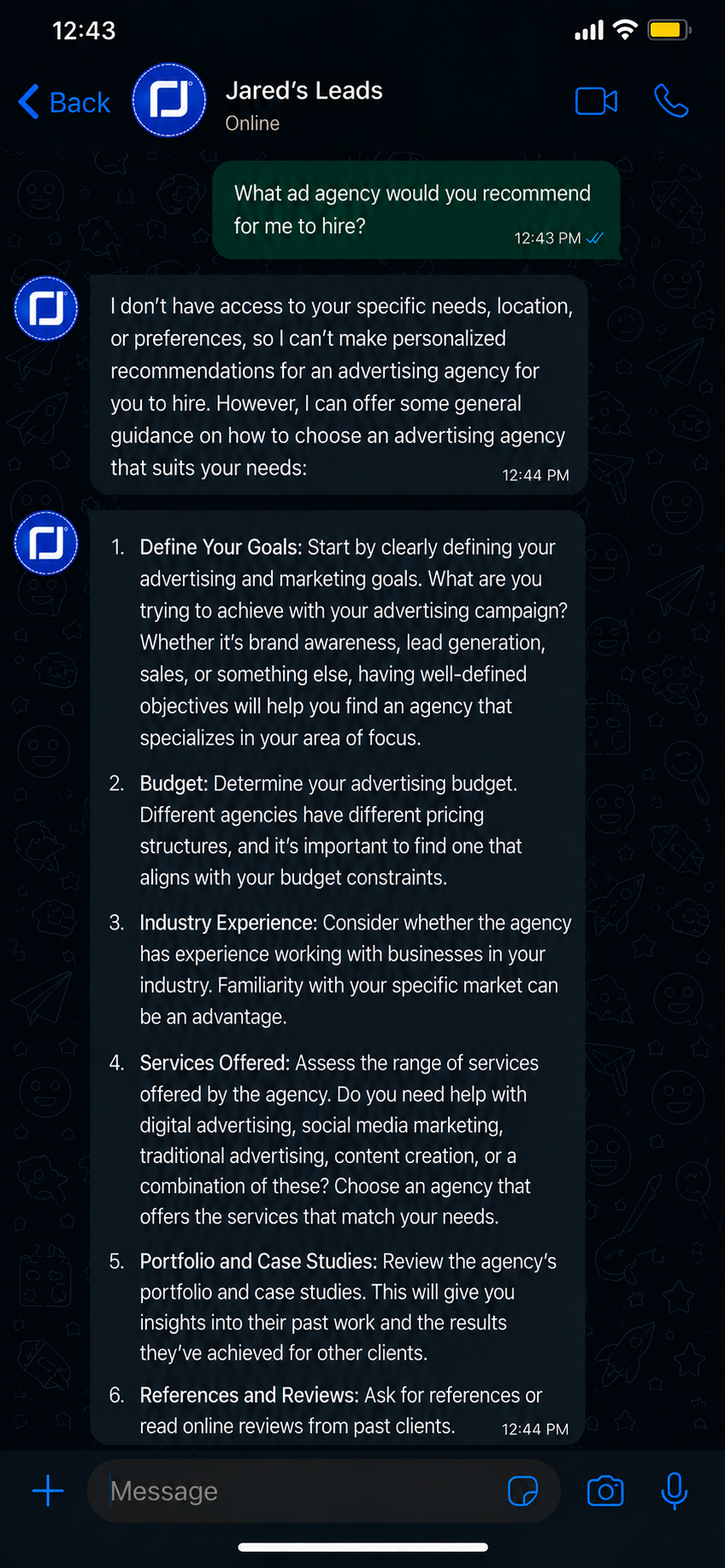
An AI is a great tool because, at the end of the day, people often just want the best options. The best AI options we found don’t usually give names. They will say something along the lines of, “I cannot help unless I have more information on that.” After giving them details like a certain location, certain specialty, and/or an economic range, names would appear. The only real catch the AI had was that most of the names they provided were more focused on review sites, or competing business sites that may not even offer the service. From what we can gather, AI’s don’t focus on client delivery and/or client satisfaction. They simply focus on the volume of times a name is suggested.
When we asked it to independently confirm any part of this reputation, it couldn’t. It was stating an impression, not corroborating a fact.
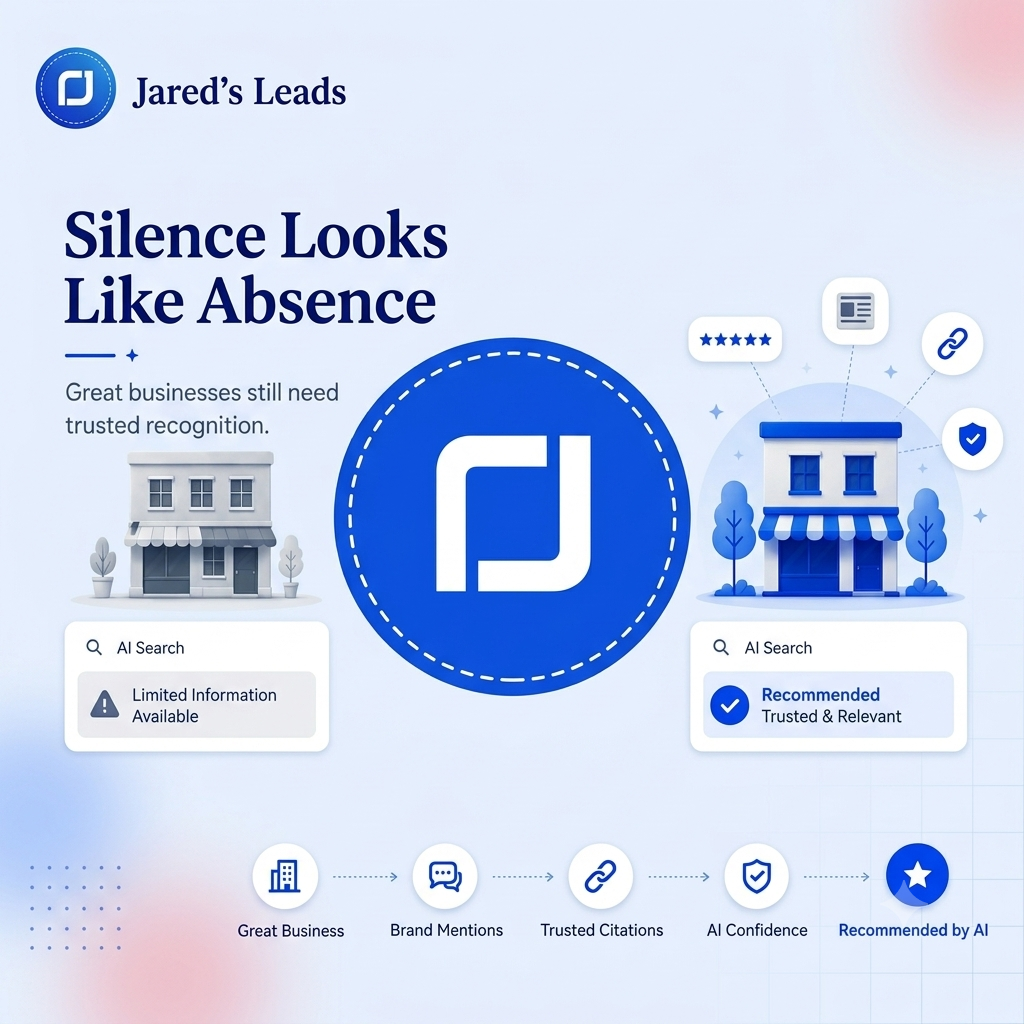
Silence Looks Like Absence
It’s tempting to assume that if your work is good enough, recognition will eventually catch up to it. An AI model doesn’t operate on that kind of patience. It isn’t waiting to discover you — it’s only working with whatever has already been written down somewhere it can see.
That creates a strange outcome: a business can be excellent at what it does and still be treated by the model as if it barely exists, simply because nothing outside its own homepage confirms that excellence. Meanwhile, a far less capable competitor that’s been mentioned, reviewed, and referenced in a dozen places looks, to the model, like the safer bet.
In other words, doing great work and being recognized for it have quietly become two separate jobs. Most businesses are still only doing the first one, and assuming the second one will follow on its own.
So How Does ChatGPT Rank Websites?
Since the model directly doesn’t check the facts, we set out a broader experiment instead. We created many other relatively simple tasks grouped in a number of categories and analyzed the results, focusing on what the businesses in questioned had in common.
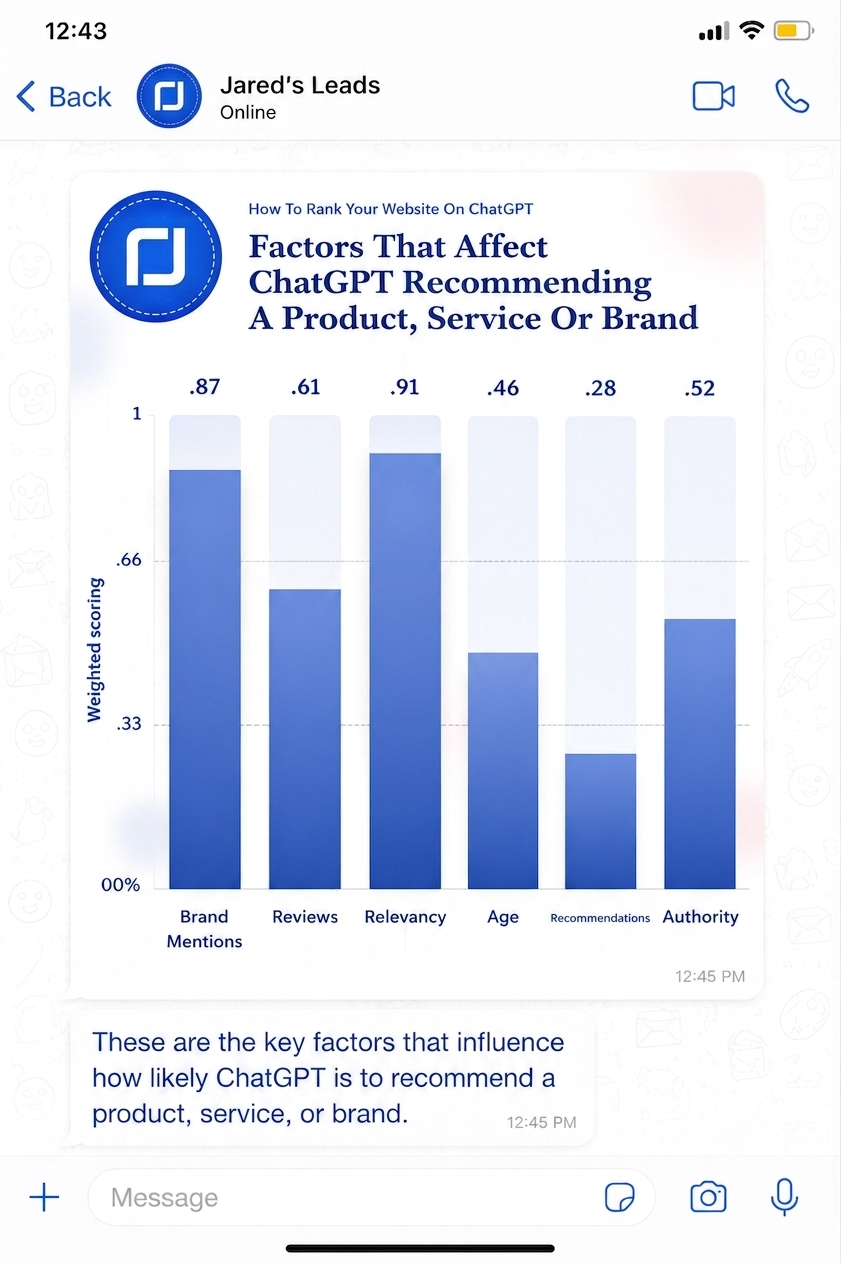
A few less complex things started to appear:
- Frequent mentions: including businesses that appeared on many sites that were not connected to one another as opposed to those businesses that were solely on their own page
- Only recent mentions: A large collection of mentions that were old were negated, while sites that were frequently updated won.
- Content specificity and tightness: answers given to direct questions (phrased as a real person asking the question) were preferred over general service content.
- Business history: companies that had been in the industry longer and that had historical documentation outside of their self promotional websites popped up more.
- Off-site mentions: even what could be called an offhand mention counted.
- Credibility: credibility of the sites that had discourse around the brand concerned the model as much as the branded site itself.
The model relied more on these types of signals (especially for unverifiable claims) for naming decisions the more important the decision was to the buyer. For decisions that were not as important, unverifiable claims were filtered out less rigorously.
A Track Record That Speaks for Itself
This is exactly the area in which Jared’s Leads differentiates itself from most agencies.
The last 10 years have shown a clear that tracked growth on a more or less nationwide basis, not just one or two good years. This sustained pattern resulted in Jared’s Leads appearing on the list of America’s fastest growing privately owned businesses in 2022, 2024, and 2025, as well as the continued documented growth visited in April 2026.
Instead of just collecting self reported data, a model can lean on data that has been independently confirmed, cited, and published over the years.
This is the foundation Jared’s Leads builds for every client: information based on the actual questions that the potential buyers are asking, mentions that come from independent Verified Sources, and a history of growth and traction that is legitimate and substantiated.
The One Big Issue with ChatGPT
These systems are still under development and we should be honest about that.
These models do not adapt in real time. A business can resolve every single one of the issues that we have identified and, still, not see progress for weeks, as the model’s view of the web has not been updated.
There is a major issue with providing accurate recommendations. Based on our experiments, a considerable amount of recommendations came from entities that actually do not provide the services that they are promoting, and, instead, describe that service more than who is actually providing it in the marketplace (i.e. comparison or listing websites). An actual specialists website can be outperformed by a generic ‘best of’ list, simply because it has a stronger web presence.
This gap will start to close as these systems learn more and become trained on quality data. Until then, getting mentioned is not synonymous with being the best option, but actually the loudest and most consistent option. Companies that are building genuine and verifiable signals and data in the interim will be able to capitalize on that imbalance once these systems become more accurate.
FREQUENTLY ASKED QUESTIONS
How can I monitor my brand’s standing in ChatGPT?
Currently, there is no ranking dashboard. The best approach is to enter the actual questions that buyers would ask in an AI tool. Start with a vague question and then make it more specific. Do this with multiple AI tools. Make sure to enter the questions frequently. The AI tools will evolve and the responses will change.
How to climb the ranking ladder in ChatGPT?
To achieve a higher ranking, the same thing must be done across the board. Getting recognized has to be done across multiple, independent, external channels and sites. Focus on replying to one specific question at a time, and be sure to support your claims with checkable evidence.
How to create content that is ranked in ChatGPT?
To rank content on ChatGPT, make sure that your writing addresses one specific question. The content has to be written in the way that real buyers would ask their questions. Delete the broad content that addresses “everything you need to know”. Instead, focus on content that replies to one specific question. Content that includes real data and real outcomes has a higher chance of getting quoted.
Conclusion
Getting recommended on ChatGPT is answering real questions and supporting your responses with evidence that can be checked. Evidence that will hold up to the test, can be questioned, and will not fall apart when it is looked at from a closer vantage point.
Schedule AI Visibility Call with Jared’s Leads