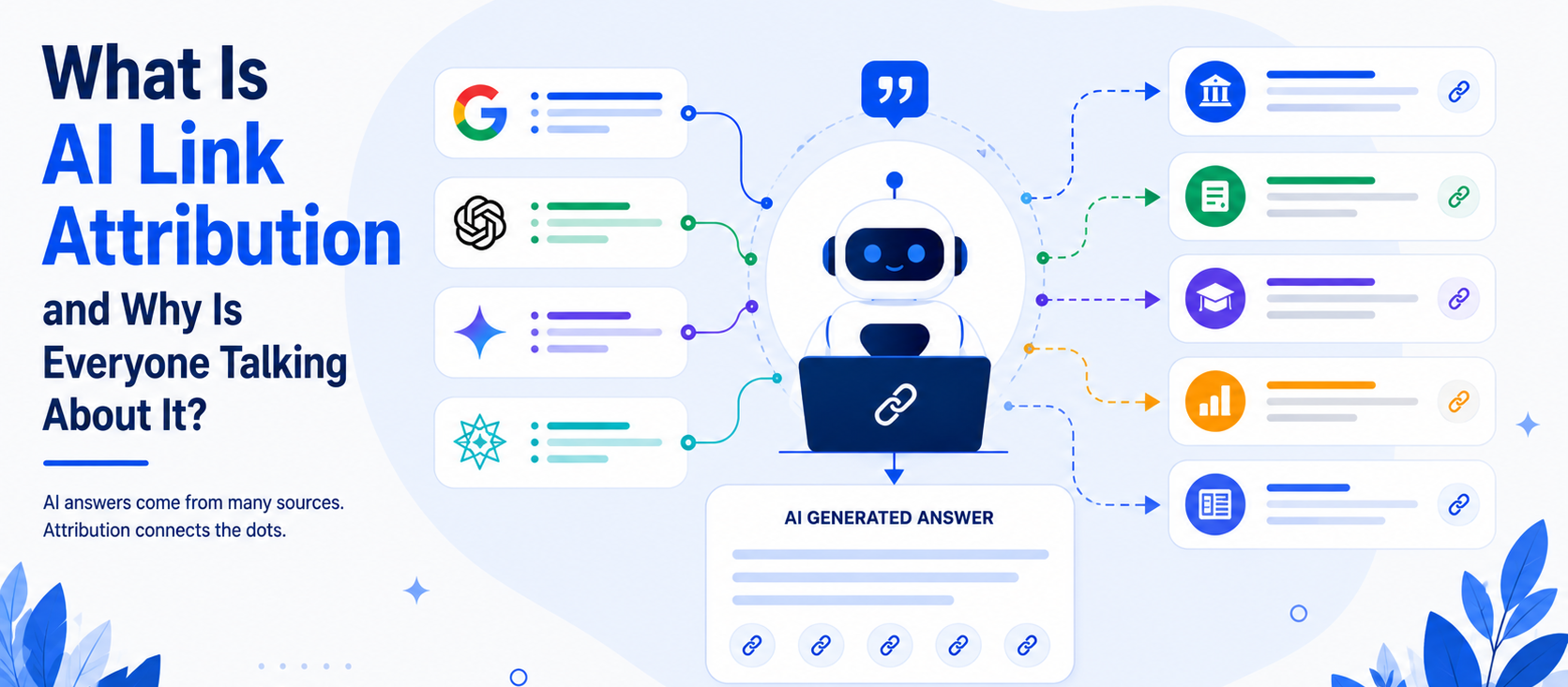
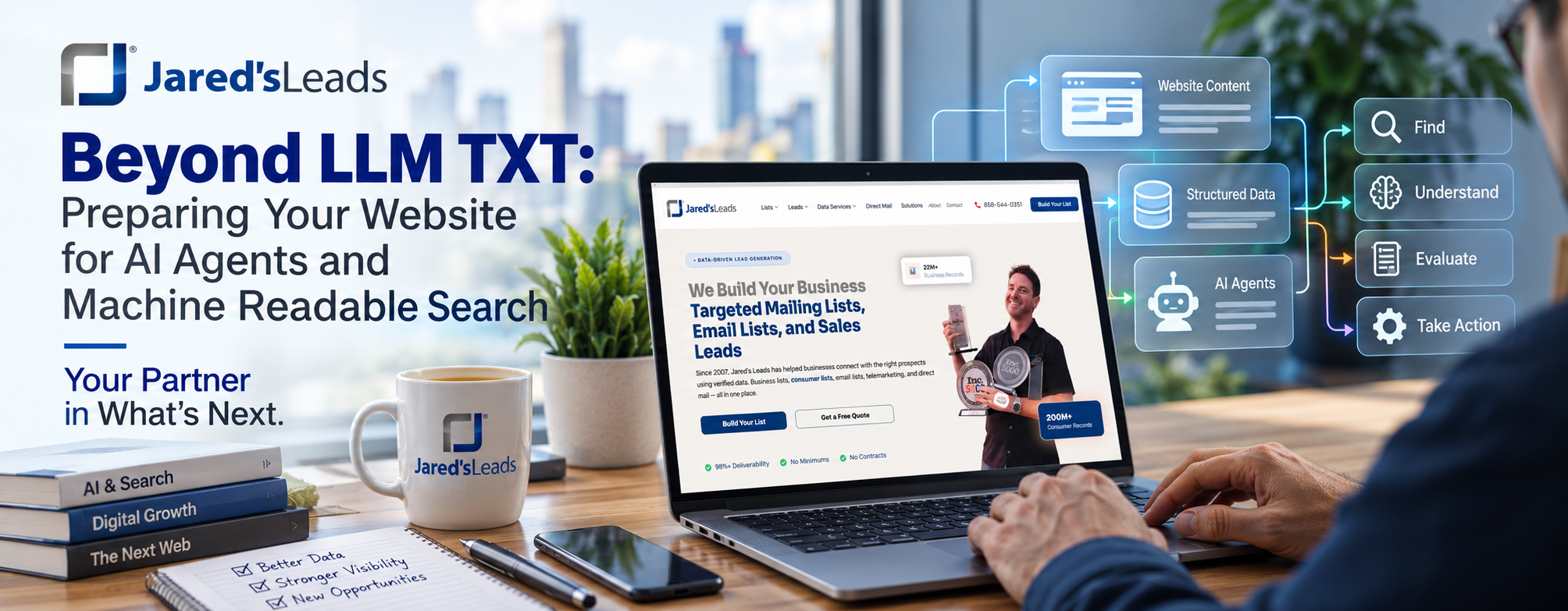
For years, businesses built websites primarily for two audiences: people and search engines. People needed clear information and an easy way to navigate the site, while search engines needed pages that could be crawled, indexed, understood, and ranked.
AI search has added another layer to that relationship. Systems such as ChatGPT, Gemini, Perplexity, and Google’s AI experiences increasingly interpret information, connect related concepts, compare sources, and produce answers that can influence what a buyer does next.
The next development is the agentic web, where software agents can increasingly research information and interact with websites or other digital systems on behalf of users. Google’s current guidance now includes an introduction to agentic experiences and explains that browser-based agents can access websites to gather information needed to complete tasks. Google’s guidance on optimizing for generative AI features
That changes the question businesses need to ask. It is no longer only whether your website can be found. It is whether the information on your website is organized clearly enough for AI systems to understand, evaluate, and potentially use.
The Evolution of the Machine-Readable Web
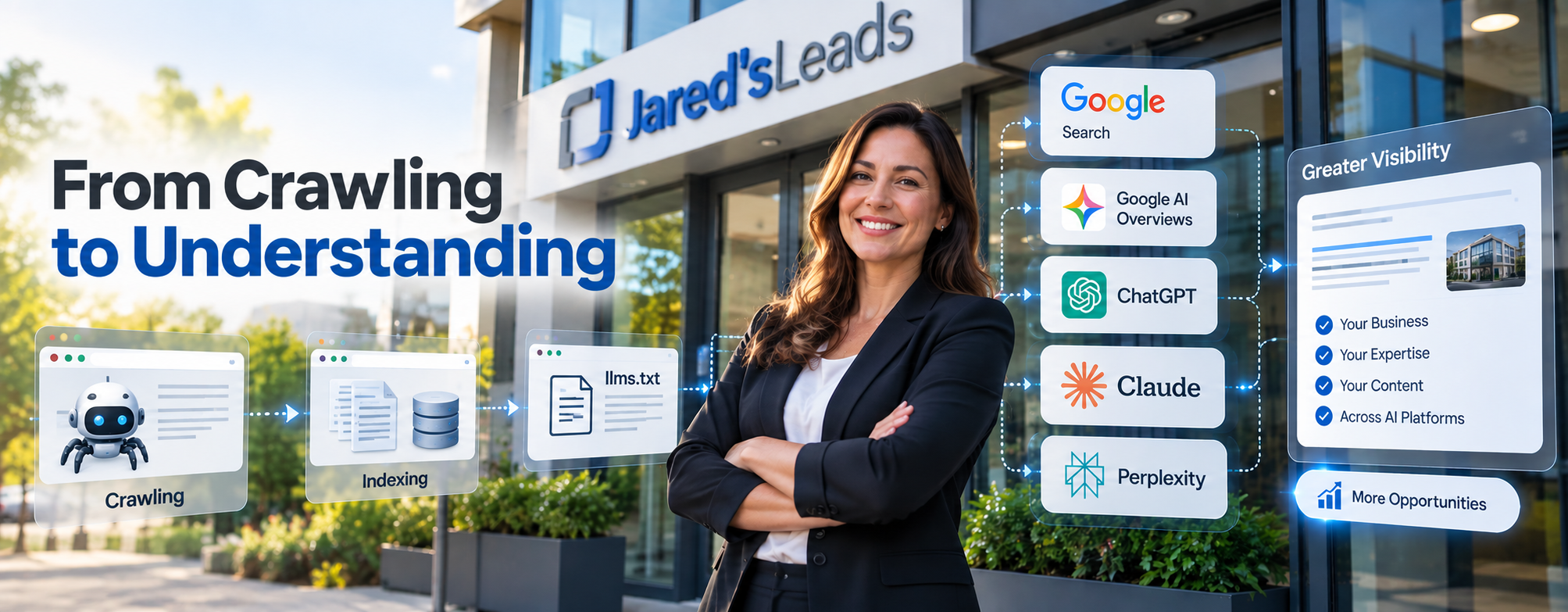
The web has used machine-readable instructions for decades. robots.txt provides crawler instructions, XML sitemaps provide an organised list of URLs, and structured data helps search engines understand entities, products, services, organisations, and relationships on a page.
llms.txt emerged from a similar idea, although it addresses a different problem. The proposal describes a Markdown file that provides AI systems with a concise overview of a website and links to more detailed resources. It is intended to make important information easier for AI systems to discover without requiring them to process an entire website first.
There is an important distinction, however. Businesses should not treat llms.txt as a Google ranking mechanism. Google’s current guidance explicitly says that Google Search does not use llms.txt or similar special AI files for ranking, and that creating one will neither help nor hurt visibility in Google Search.
That does not make the concept irrelevant. A business may still choose to maintain machine readable resources for systems that use them. The larger lesson is that businesses should understand what a particular technical resource is designed to accomplish rather than assuming every new AI file is an SEO requirement.
For businesses beginning this work, Jared’s Leads approaches the technical side through its broader LLM SEO services, which include website structure, entities, schema, content, authority, and ongoing AI visibility measurement.
The more interesting development is what happens beyond helping an AI system read a website.
Emerging approaches are beginning to explore how websites can communicate what an AI agent can actually do. Agent manifests and related protocols are exploring ways to describe capabilities, APIs, authentication, and supported interactions. These approaches are still developing, so they should be treated as an emerging part of the web rather than universal standards.
The progression is becoming clearer: websites need to be discoverable, understandable, and increasingly capable of supporting machine interaction where appropriate.
What Comes After llms.txt?

The important question is not whether the next file will be called vendor.txt, agents.txt, or something else. The important question is what information an AI system or agent needs when it encounters your business.
A software company may need to make its products, pricing, integrations, API documentation, authentication requirements, supported platforms, security certifications, compliance information, and technical limitations easy to understand.
A professional services company may need to clearly explain its services, industries served, geographic coverage, qualifications, processes, policies, and contact options.
This is where structured JSON LD, APIs, documentation, machine readable resources, and clear information architecture become important. None of them is a magic switch for AI visibility. Together, however, they can create a much clearer information environment.
A business should therefore ask a different question:
What would an AI system need to know about my company to accurately evaluate it?
That question is more useful than simply asking which new file should be uploaded to the root directory.
The same principle applies to structured information. Google’s current guidance continues to emphasize clear technical structure, crawlability, useful content, and appropriate structured data as foundational practices for generative AI search.
Jared’s Leads’ LLM SEO packages reflect this broader approach, with technical schema and profile clarity included alongside prompt research, entity development, content, tracking, and reporting.
Optimizing for the Technical Buyer Agent

The technical buyer agent is particularly important for B2B companies because purchasing decisions often involve multiple people and multiple criteria.
Imagine a company evaluating a software provider. The buyer may need to know whether the product integrates with its existing systems, whether an API is available, how authentication works, whether the provider meets security requirements, what the pricing model looks like, whether customer data is handled according to specific requirements, and whether the company can support the expected volume.
A human buyer can spend hours researching those questions. An AI system assisting that buyer needs to locate and interpret the relevant information efficiently.
This means a business website should not force important information into isolated sales presentations or make every technical answer available only after a form submission. If a company expects AI systems to understand its offering, the important facts need to exist somewhere that can be discovered and interpreted.
Pricing is a good example. A company does not necessarily need to publish every commercial detail, but the pricing structure should be understandable. If there are different plans, usage limits, implementation requirements, or enterprise considerations, those conditions should be explained clearly.
Security and compliance information deserves the same treatment. Certifications, privacy policies, data handling information, security documentation, and regulatory details can become important decision factors when an AI system is comparing providers.
Technical documentation is another critical area. APIs, integrations, supported platforms, implementation requirements, and limitations should be documented in a way that is useful to developers and understandable to machines.
The website increasingly needs to function as more than a marketing brochure. It needs to serve as a reliable source of business information.
What Information Should an AI Agent Be Able to Find?

A useful way to evaluate agent readiness is to imagine that an AI system has never heard of your company and needs to determine whether your business is relevant to a particular buyer.
The first layer is business identity. Your company name, brand identity, locations, services, industries served, and contact information should be consistent and easy to understand.
The second layer is product and service information. Each important offering should explain what it does, who it serves, what problem it addresses, and what makes it different from related options.
The third layer is technical information. Software companies should make APIs, integrations, documentation, authentication requirements, supported technologies, and technical limitations easy to find. Service companies can apply the same principle to explaining processes, requirements, deliverables, and operating models.
The fourth layer is trust information. Credentials, certifications, case studies, independent reviews, expert contributions, industry recognition, and credible third party references can help establish why the information should be trusted.
The fifth layer is action information. If a website supports an API, booking process, transaction, consultation request, or another digital action, the path to that action should be clear.
This is where the difference between an AI ready website and an agent ready website becomes useful. A website can contain excellent information without offering machine accessible actions. An agent ready website considers both information and interaction.
Jared’s Leads’ broader approach to traditional SEO versus LLM SEO is relevant here because these strategies should not be treated as competing systems. A strong technical foundation still matters, while AI visibility adds another layer to how businesses need to organize and communicate their information.
Four Steps to Make Your Website More Agent-Friendly
The first step is to make important information directly accessible. Review your most important commercial, technical, and informational pages and ask whether someone can quickly locate the information required to evaluate your business. Essential information should not depend entirely on complicated navigation, unnecessary scripts, or hidden interactions.
The second step is to use structured data appropriately. Schema markup can help search engines understand entities and relationships represented on a page. It should accurately reflect the information rather than being added simply because a particular schema type sounds useful. Google continues to recommend structured data as part of broader SEO practices, while making clear that there is no special schema that guarantees visibility in generative AI features.
The third step is to build useful technical documentation. If your company offers software, APIs, integrations, or technical services, documentation should be treated as part of the website’s information architecture. Pricing, security, compliance, implementation, and support information should receive the same consideration.
The fourth step is to evaluate machine-readable resources. llms.txt may be useful for systems that support it, while emerging agent capability formats are worth monitoring. The important point is to implement these resources because they solve a genuine information or interaction problem, not because adding a new file is assumed to produce AI visibility.
Businesses can also use the LLM SEO packages as a reference for the types of technical, entity, content, tracking, and reporting activities that can form part of a broader AI visibility program.
What Businesses Should Not Do
The rapid development of AI search has created plenty of opportunities for exaggerated claims. Businesses should be careful about treating every new file, markup format, or AI optimization technique as a ranking shortcut.
Adding llms.txt does not automatically make a company visible in ChatGPT. Creating an agent manifest does not guarantee that an agent will use it. Adding structured data that does not accurately represent the page does not create authority.
Google’s own guidance is particularly useful here because it explicitly warns against many of the popular assumptions surrounding generative AI search. It states that businesses do not need special AI text files to appear in Google Search and that traditional SEO fundamentals remain foundational.
The durable approach is to improve the underlying information environment.
If your pricing is unclear, improve the pricing information. If your services are poorly explained, improve the service pages. If your technical documentation is incomplete, expand it. If your business information is inconsistent, correct it. If important entities and relationships are unclear, improve the site’s architecture and structured information.
Those improvements remain useful regardless of which AI protocol becomes dominant.
How Jared’s Leads Helps Build an LLM-Ready Website
Building an LLM ready website requires more than adding schema or publishing an llms.txt file. The larger challenge is understanding what information AI systems need in order to recognize a business, understand its services, connect its expertise with buyer questions, and evaluate its authority.
That is where Jared’s Leads takes a broader approach to LLM SEO. Its published framework is built around five connected stages: discovering the questions people ask AI about a business and its category, organizing the site through architecture, entities and schema, creating original expert content, promoting authority through citations and quality backlinks, and measuring AI visibility over time.
This matters because a technically sound website can still provide AI systems with very little useful context. A business may have clean code and structured data while having weak explanations of its services, unclear entities, limited supporting content, or little independent authority.
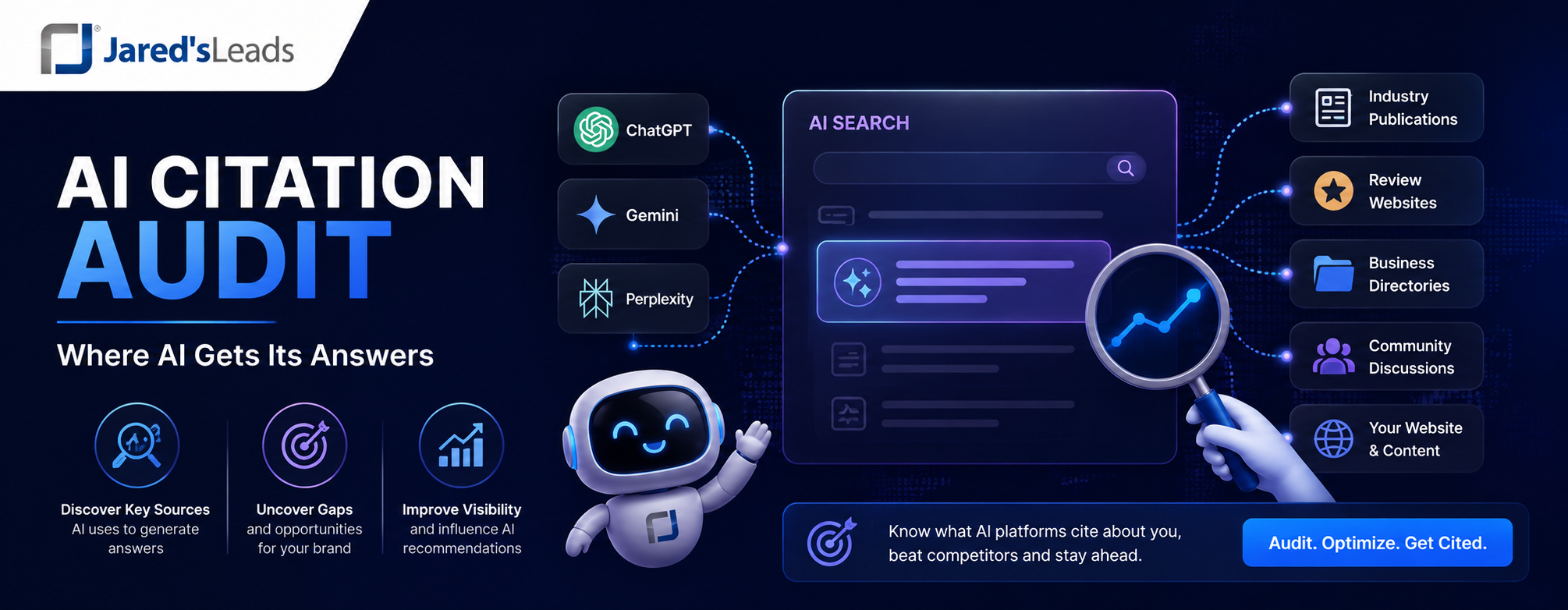
Jared’s Leads can therefore approach LLM readiness as a combination of technical foundation, content, entity clarity, authority, and measurement. Its AI Visibility Audit is designed to help businesses understand how visible they are across AI and search platforms and identify where improvement may be needed.
The objective should not be to make a website look “AI optimized.” It should be to make the business genuinely easier for people, search engines, AI systems, and eventually software agents to understand.
How to Evaluate Your Website Before You Build for Agents
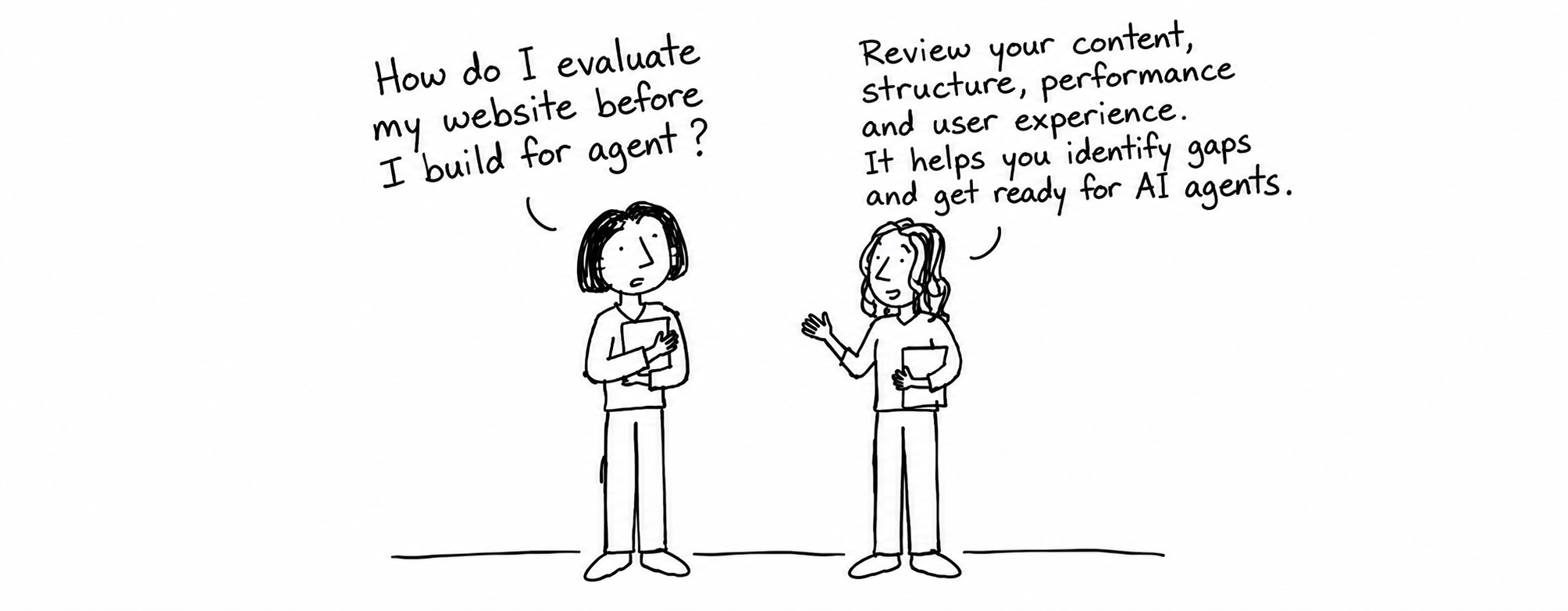
Before implementing emerging technologies, businesses should first audit the information they already have.
Start with the company’s identity. Is the company consistently described across the website and important external profiles? Are the primary services clearly defined? Are the industries, locations, products, and audiences easy to understand?
Then examine the commercial information. Can a potential buyer understand what is being offered, who it is designed for, what it costs or how pricing works, and what the next step should be?
Next, examine the technical layer. Can developers find API documentation, integrations, security information, implementation requirements, and support resources without unnecessary friction?
Finally, examine the authority layer. Does the wider web provide credible evidence supporting the company’s expertise and claims?
This type of review is more valuable than immediately adding every emerging AI file because it identifies the underlying information gaps first.
A business that wants an external assessment can use the Jared’s Leads AI Visibility Audit to examine its current AI and search visibility before deciding which technical or content improvements make sense.
Frequently Asked Questions
Q.1. Is llms.txt required for AI visibility?
No. llms.txt is an emerging approach for providing AI systems with a concise overview of a website, but Google explicitly says that Google Search does not use llms.txt for ranking and that creating one does not improve or harm Google Search visibility. Businesses may still use it for other systems that support the format, but it should not be treated as a replacement for technical SEO or useful content.
Q.2. What is the difference between an AI ready website and an agent ready website?
An AI ready website focuses on making its information understandable, trustworthy, structured, and accessible to AI systems. An agent ready website goes further by considering how software may interact with the website or its connected systems. That can include APIs, authentication, machine readable documentation, transaction capabilities, or emerging agent protocols where they are genuinely relevant.
Q.3. Should every business create vendor.txt or an agent manifest?
No. Emerging agent manifest concepts are still developing, and there is no universal requirement for every business to implement them. Businesses should first understand what problem a particular format solves and whether that capability is relevant to their website. The more durable investment is clear information architecture, useful content, accurate business information, technical accessibility, and documented capabilities.
Q.4. Does structured data help AI systems understand a website?
Structured data can provide explicit information about entities and relationships and remains an important part of technical SEO. However, it should accurately represent the page and should not be treated as a guarantee of AI citations. Google’s current guidance continues to position structured data within broader SEO fundamentals rather than as a special AI ranking mechanism.
Q.5. How can Jared’s Leads help make a website LLM ready?
Jared’s Leads approaches LLM readiness through AI visibility analysis, buyer focused prompt research, technical optimization, entity development, content, authority building, and ongoing measurement. Its current LLM SEO framework specifically includes discovery, organization, content creation, promotion, and measurement.
Final Takeaway
The next stage of AI visibility is unlikely to be determined by one file, one schema type, or one optimization trick. The web is becoming more machine-readable, while AI systems are becoming increasingly capable of moving from finding information to evaluating it and, in some situations, interacting with digital systems.
Businesses therefore need to think beyond whether their website can rank or whether an AI system can quote one of their articles. The more useful question is whether the business has created a clear information environment that explains who it is, what it offers, who it serves, why it should be trusted, and how its products or services can be evaluated or used.
llms.txt is part of that conversation, but it is not the destination. Emerging agent manifests may eventually become useful in specific situations. APIs, structured data, technical documentation, accessible content, clear service pages, and consistent business information are already valuable regardless of which protocol becomes dominant.
The businesses best positioned for the agentic web will not necessarily be the ones that adopt every new file first. They will be the ones that make their websites genuinely understandable to people, search engines, AI systems, and increasingly capable software agents.
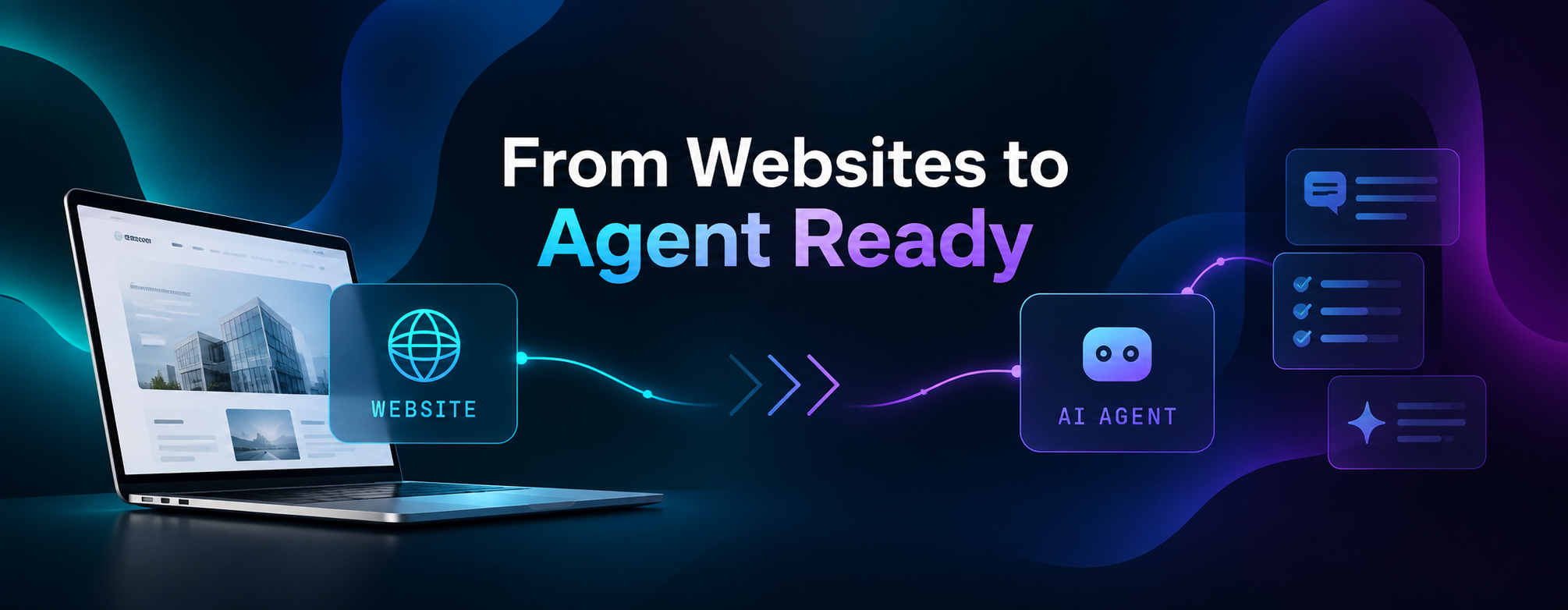
The real shift is therefore from being discoverable, to being understandable, to eventually being usable by machines.